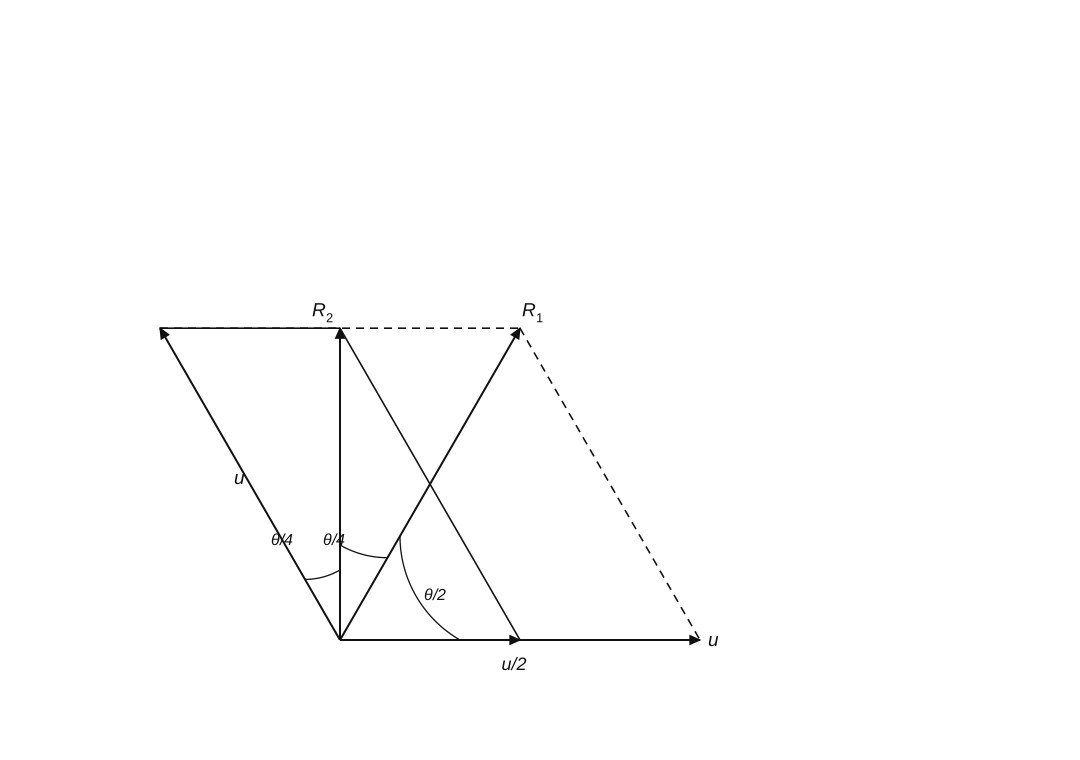
A particle has two velocities of equal magnitude inclined to each other at an angle θ. If one of them is halved, the angle between the other and the original resultant velocity is bisected by the new resultant. Then θ is
(A)90∘
(B)120∘✓ Correct
(C)45∘
(D)60∘
Answer: (B)
Solution
Take the velocity that is left unchanged along the reference direction and let each original velocity have magnitude u with angle θ between them. Because the two original velocities are equal in size, their resultant bisects the angle between them and so makes an angle 2θ with the reference direction. After the second velocity is halved to 2u, the new resultant makes an angle β with the reference given by tanβ=u+2ucosθ2usinθ=2+cosθsinθ. The requirement that this new resultant bisects the angle between the unchanged velocity and the original resultant means β=4θ, so tan4θ=2+cosθsinθ. Writing φ=4θ and clearing the fraction gives 2sinφ+sinφcos4φ=cosφsin4φ, and since cosφsin4φ−sinφcos4φ=sin3φ this becomes 2sinφ=sin3φ. Using sin3φ=3sinφ−4sin3φ reduces it to 4sin3φ=sinφ, hence sin2φ=41 and sinφ=21. Thus φ=30∘ and θ=120∘.
JEE Main · 2006 · 30 Apr 2006 · Offline · Single correct option