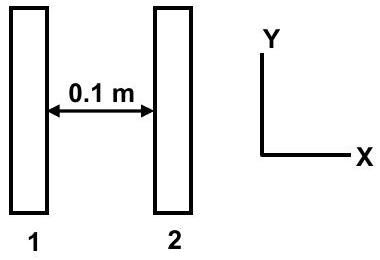
Two insulating plates are both uniformly charged in such a way that the potential difference between them is V2−V1=20V. (i.e. plate 2 is at a higher potential). The plates are separated by d=0.1m and can be treated as infinitely large. An electron is released from rest on the inner surface of plate 1. What is its speed when it hits plate 2? (e=1.6×10⁻¹⁹C, me=9.11×10⁻³¹kg)
(A)32×10−19m/s
(B)2.65×10⁶m/s✓ Correct
(C)7.02×10¹²m/s
(D)1.87×10⁶m/s
Answer: (B)
Solution
The electron is released from rest at the lower-potential plate and accelerated across to the higher-potential plate through a potential difference of 20 V. The work done on it, eV, appears as kinetic energy: 21mv2=eV. Hence v=m2eV=9.11×10−312×1.6×10−19×20≈2.65×10⁶ m/s. The plate separation does not enter this energy balance.
JEE Main · 2006 · 30 Apr 2006 · Offline · Single correct option