If the domain of the function f(x)=log(0.6)(x2−42x−5) is (−∞,a]∪{b}∪[c,d)∪(e,∞), then the value of a+b+c+d+e is ______.
Answer: 4
Solution
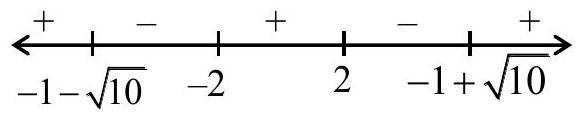
For the square root to be defined the logarithm must be non-negative, so log0.6x2−42x−5≥0. Since the base 0.6<1, this forces 0<x2−42x−5≤1, which already requires x=±2 and x=25. The inequality x2−42x−5≤1 is equivalent to (2x−5)2≤(x2−4)2, i.e. (x2−4)2−(2x−5)2≥0. Factorising, [(x2−4)−(2x−5)][(x2−4)+(2x−5)]=(x−1)2(x2+2x−9)≥0. As (x−1)2≥0, this holds when x2+2x−9≥0, that is x≤−1−10 or x≥−1+10, together with the isolated point x=1 at which the square vanishes. Discarding x=25 (which lies in x≥−1+10) breaks that ray, giving the domain (−∞,−1−10]∪{1}∪[−1+10,25)∪(25,∞). Hence a=−1−10,b=1,c=−1+10,d=e=25, and a+b+c+d+e=(−1−10)+1+(−1+10)+25+25=4.