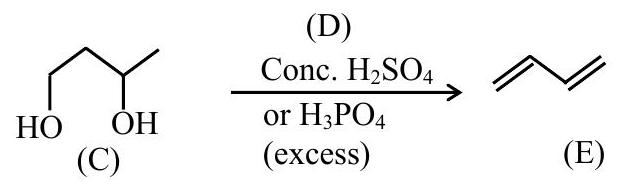
Consider compounds A,B and C with following structural formulae A=CH3−CH2−CH2−CH2−CH2−OH B=CH2=CH−CH2−CH2−CH3 C=HO−CH2−CH2−CH(OH)−CH3 For the conversion of B from A , reagent (D) required is ____ and structural formula of product (E) obtained when C undergoes same reaction using excess reagent (D) is ____
(A)D: Conc. H2SO4, E: CH2=CH−CH(OH)/CH3
(B)D: PCC, E: HO−CH2−CH2−CH=CH2
(C)D: PCC, E: CH2=CH−CH=CH2
(D)D: Conc. H2SO4 or H3PO4, E: CH2=CH−CH=CH2✓ Correct
Answer: (D)
Solution
Turning 1-pentanol into 1-pentene is a dehydration, the removal of water from an alcohol, achieved by a hot acid catalyst such as concentrated H2SO4 or H3PO4; the oxidant PCC would instead convert the alcohol to a carbonyl compound and is unsuitable. Applying the same acid in excess to butane-1,3-diol, HOCH2CH2CH(OH)CH3, strips away both hydroxyl groups to create two double bonds, giving buta-1,3-diene. Reagent D is concentrated H2SO4 or H3PO4 and product E is CH2=CH−CH=CH2.
JEE Main · 2026 · 05 Apr 2026 · Shift 1 · Single correct option