JEE Main · 2026 · 08 Apr 2026 · Shift 2 · Haloalkanes and Haloarenes

WhatsApp Email
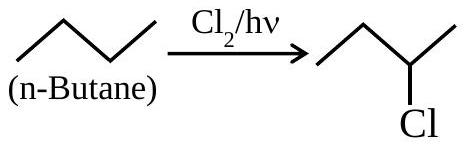
n-Butane on monochlorination under photochemical conditions gives an optically active compound "P". "P" on further chlorination gives dichloro compounds.

The number of dichloro compounds obtained (ignore stereoisomers) is :
  1. (A)3
  2. (B)4✓ Correct
  3. (C)5
  4. (D)6

Answer: (B)

Solution

Monochlorination of n-butane under light gives, as the optically active product P, 2-chlorobutane, , which has a stereocentre at C-2. A second chlorine can replace a hydrogen at each of its four distinct carbons: at C-1 to give 1,2-dichlorobutane, at C-2 to give 2,2-dichlorobutane, at C-3 to give 2,3-dichlorobutane, and at C-4 to give 1,3-dichlorobutane. Ignoring stereoisomers, four dichloro compounds are obtained.

JEE Main · 2026 · 08 Apr 2026 · Shift 2 · Single correct option
More JEE Main questions on Haloalkanes and Haloarenes

  1. The correct order of reactivity of in methanol with the following nucleophiles is and
    JEE Main 2026View solution →
  2. The correct order of the rate of reaction of the following reactants with nucleophile by mechanism is :
    (Given : Structure I and II are rigid)
    JEE Main 2026View solution →
  3. The correct order of reactivity of the following benzyl halides towards reaction with KCN is:
    JEE Main 2026View solution →
  4. The correct order of the rate of the reaction for the following reaction with respect to nucleophiles is:
    JEE Main 2026View solution →
  5. Given below are four compounds:
    (a) n-propyl chloride
    (b) iso-propyl chloride
    (c) sec-butyl chloride
    (d) neo-pentyl chloride

    Percentage of carbon in the one which exhibits optical isomerism is:
    JEE Main 2026View solution →
  6. Consider the following reaction :


    The product Y formed is :
    JEE Main 2026View solution →