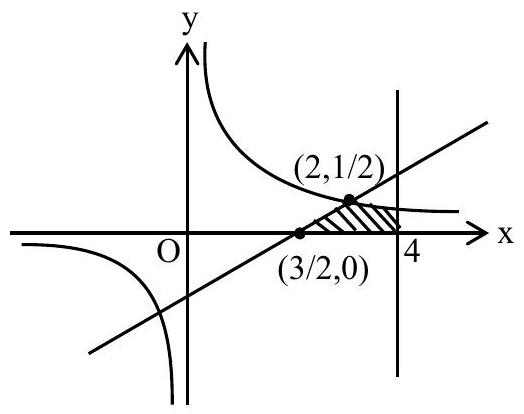
Let f:(1,∞)→R be function defined as f(x)=x+1x−1. Let fi+1(x)=f(fi(x)), i=1,2,…,25, where f1(x)=(x). If g(x)+f26(x)=0, x∈(1,∞), then the area of the region bounded by the curves y=g(x),2y=2x−3,y=0 and x=4 is:
(A)81+loge2✓ Correct
(B)41+loge2
(C)65+3loge2
(D)65+loge2
Answer: (A)
Solution
Iterating f(x)=x+1x−1 gives f2(x)=−x1, f3(x)=1−x1+x and f4(x)=x, so the iterates repeat with period 4. Since 26≡2(mod4), f26(x)=f2(x)=−x1, hence g(x)=−f26(x)=x1. The region is bounded by y=x1, the line y=x−23, the x-axis and x=4. The line meets the x-axis at x=23 and meets y=x1 where x1=x−23, i.e. 2x2−3x−2=0, giving x=2. The area is the triangle under the line from x=23 to x=2 plus the region under y=x1 from x=2 to x=4:
21⋅21⋅21+∫24xdx=81+ln2.
JEE Main · 2026 · 08 Apr 2026 · Shift 2 · Single correct option