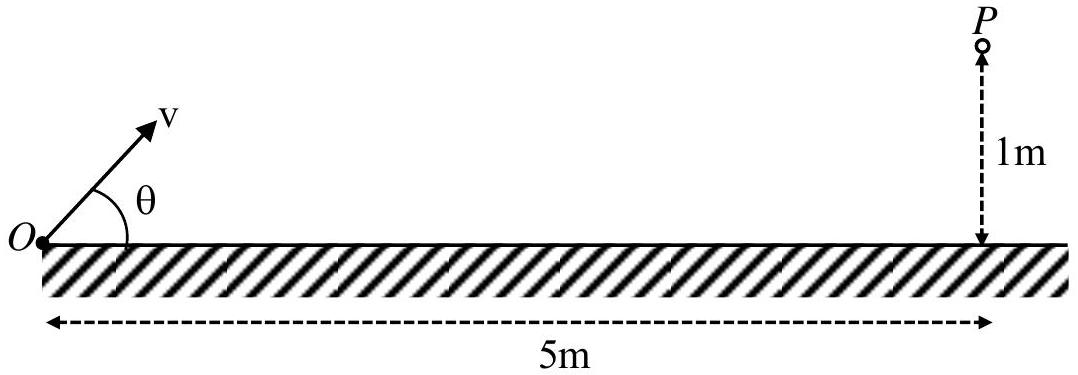
A particle is thrown with a speed v from a point O at an angle θ with the horizontal plane such that it passes through the point P at a height of 1 m and horizontal distance of 5 m from O, as shown in the figure. If acceleration due to gravity is gms−2, then the correct statement (s) is/are :
(A)If θ=45∘, then v=25gms−1✓ Correct
(B)If θ=45∘, the particle reaches its maximum height before it reaches P.✓ Correct
(C)If θ=30∘, the particle reaches its maximum height after reaching P.
(D)If θ=tan−1(51), then v=125gms−1
Answer: (A), (B)
Solution
Trajectory equation: y=xtanθ−21v2cos2θgx2. Point P(5,1) lies on trajectory.
(A) For θ=45∘: 1=5−2v2(1/2)25g gives v=25g m/s ✓
(B) Range R=gv2sin90∘=6.25 m. Maximum height occurs at 2R=3.125 m < 5 m, so particle reaches maximum height before P ✓
(C) For θ=30∘: 2R=3.83 m < 5 m, so particle reaches maximum height before P, not after ✗
(D) For θ=tan−1(51): substituting gives 1=1−2v2×(25/26)g×25, which requires v→∞ ✗
JEE Advanced · 2026 · 17 May 2026 · Paper 1 · One or more correct options