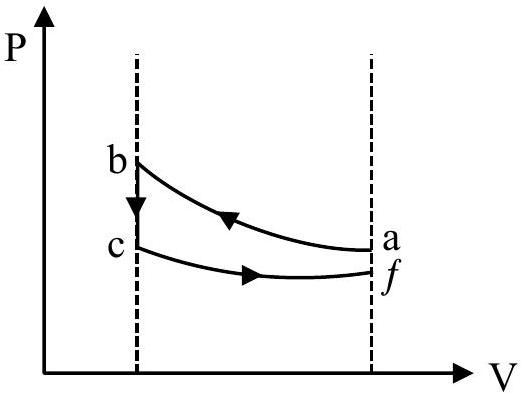
Ten moles of an ideal monoatomic gas, initially in state a at atmospheric pressure and temperature Ta=27∘C, is enclosed in a metal cylinder of volume V0 fitted with a frictionless piston. The gas is suddenly compressed to state b with volume V0/3. Now, keeping the piston stationary, the cylinder is submerged in a water bath of temperature 11°C until the gas reaches the temperature of the water bath, which is denoted as state c. Finally, while still in the water bath, the piston is brought slowly to its initial position, which is denoted as state f. If R is universal gas constant, then the correct option(s) is/are: [Given: 91/3=2.08]
(A)(see structure)✓ Correct
(B)The change in internal energy in going from state a to b is 4860R.✓ Correct
(C)The net change in the internal energy in the whole process is -240R.✓ Correct
(D)The pressure and temperature of the state b are 2.08 times the atmospheric pressure and 624 K, respectively.
Answer: (A), (B), (C)
Solution
Process a→b: adiabatic compression. Process b→c: isochoric cooling. Process c→f: isothermal expansion. The P-V diagram matches option (A). Correct.
(B) For adiabatic process: TVγ−1=constant, so Tb=Ta(V0/(V0/3))2/3=300×32/3=300×91/3=624 K. Change in internal energy: ΔU=nCvΔT=10×23R×(624−300)=4860R. Correct.
(C) Net change in internal energy: ΔUnet=nCv(Tf−Ta)=10×23R×(284−300)=−240R. Correct.
(D) Tb=624 K is correct, but Pb=P0×35/3=P0×35/3≈6.24P0, not 2.08P0. Incorrect.
JEE Advanced · 2026 · 17 May 2026 · Paper 2 · One or more correct options