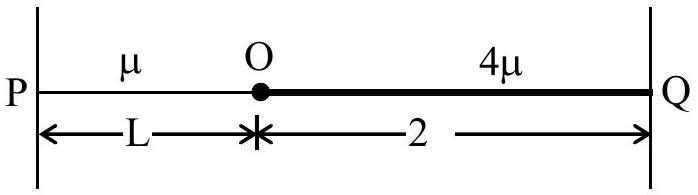
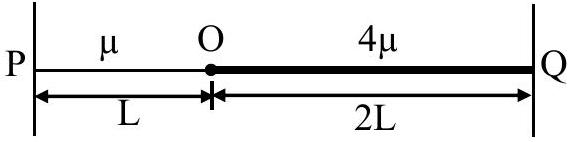
Two uniform string of mass per unit length μ and 4μ, and length L and 2L, respectively, are joined at point O, and tied at two fixed ends P and Q, as shown in the figure. The strings are under a uniform tension T. If we define the frequency v0=2L1μT, which of the following statement(s) is (are) correct ?
(A)With a node at O , the minimum frequency of vibration of the composite string is v0.✓ Correct
(B)With an antinode at O , the minimum frequency of vibration of the composite string is 2v0.
(C)When the composite string vibrates at the minimum frequency with a node at O , it has 6 nodes, including the end nodes.✓ Correct
(D)No vibrational mode with an antinode at O is possible for the composite string.✓ Correct
Answer: (A), (C), (D)
Solution
Wave speeds: C1=μT, C2=4μT=2C1. For a node at O: L=2nλ1, 2L=2mλ2. Since λ1C1=λ2C2, we get m=4n. Minimum frequency occurs at n=1,m=4: vmin=2LC1=v0 (A correct). The string has 1 loop in PO and 4 loops in OQ, giving 6 nodes total (C correct). For an antinode at O: L=(2n+1)4λ1, 2L=(2m+1)4λ2. This requires 4=2n+12m+1 (even = odd/odd), which is impossible (D correct). Option B is incorrect as no antinode mode exists.
JEE Advanced · 2024 · 26 May 2024 · Paper 1 · One or more correct options