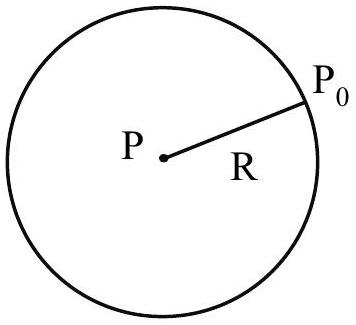
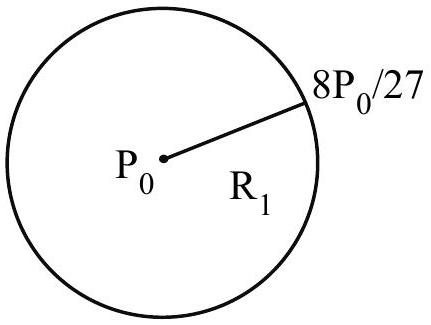
A spherical soap bubble inside an air chamber at pressure P0=105Pa has a certain radius so that the excess pressure inside the bubble is ΔP=144Pa. Now, the chamber pressure is reduced to 8P0/27 so that the bubble radius and its excess pressure change. In this process, all the temperatures remain unchanged. Assume air to be an ideal gas and the excess pressure ΔP in both the cases to be much smaller than the chamber pressure. The new excess pressure ΔP in Pa is ____.
Answer: 96
Solution
For a soap bubble, the excess pressure is ΔP=R4T, where T is surface tension and R is radius.
Case 1:
P=P0+ΔP=P0+R4T
Since ΔP≪P0, we approximate P≈P0.
Case 2: Chamber pressure becomes P0′=278P0, radius becomes R1:
P1=278P0+R14T
For isothermal process with ideal gas:
PV=P1V1
P0⋅34πR3=278P0⋅34πR13
R3=278R13⇒R1=23R
The new excess pressure:
ΔP1=R14T=3R/24T=32⋅R4T=32×144=96 Pa
JEE Advanced · 2024 · 26 May 2024 · Paper 2 · Integer answer