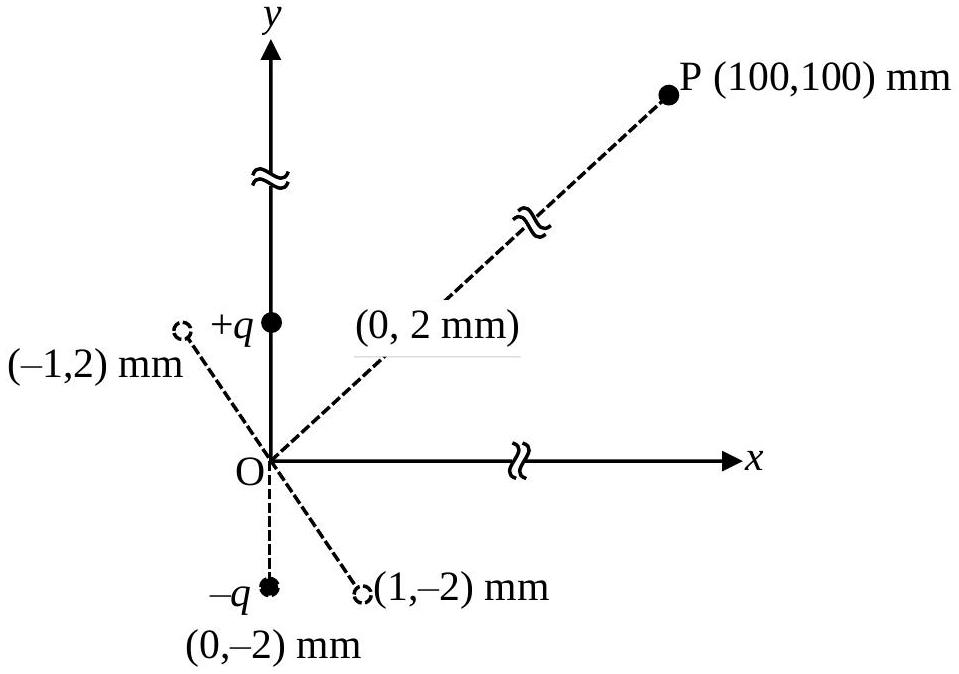
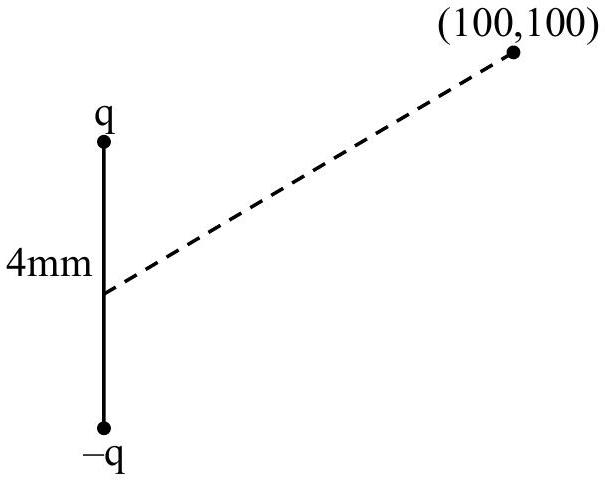
An electric dipole is formed by two charges +q and −q located in xy-plane at (0,2) mm and (0,−2) mm, respectively, as shown in the figure. The electric potential at point P(100,100) mm due to the dipole is V0. The charges +q and −q are then moved to the points (−1,2) mm and (1,−2) mm, respectively. What is the value of electric potential at P due to the new dipole ?
(A)V0/4
(B)V0/2✓ Correct
(C)Vo/2
(D)3V0/4
Answer: (B)
Solution
The electric potential due to a dipole at a point is given by V=r3KP⋅r.
Initially, P1=4qj^ (dipole moment magnitude 4q mm along y-axis) and r=100(i^+j^) mm. This gives V0=(1002)3K(100⋅4q).
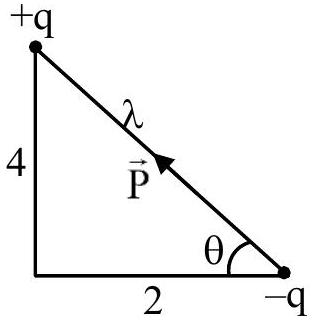
After moving the charges, the new dipole has moment P2=qℓ where ℓ=22 mm at angle θ with tanθ=2. The dipole moment components are P2=P2[−cosθi^+sinθj^].
The new potential is V=r3KP2⋅r=(1002)3K(100P2)(−cosθ+sinθ).
With cosθ=1/5 and sinθ=2/5, we get −cosθ+sinθ=1/5.
Since P2=q⋅22⋅5/5=2q2, the ratio gives: V=V0⋅4q2q2⋅(−1/5+2/5)⋅5=V0⋅21⋅1=2V0
JEE Advanced · 2023 · 04 Jun 2023 · Paper 2 · Single correct option