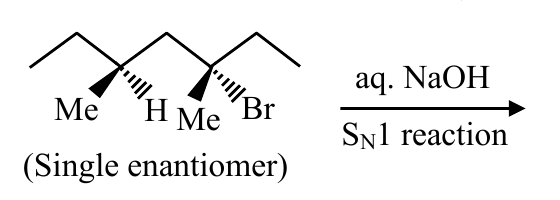
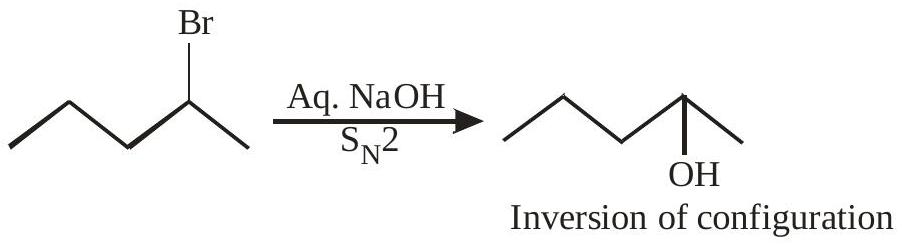
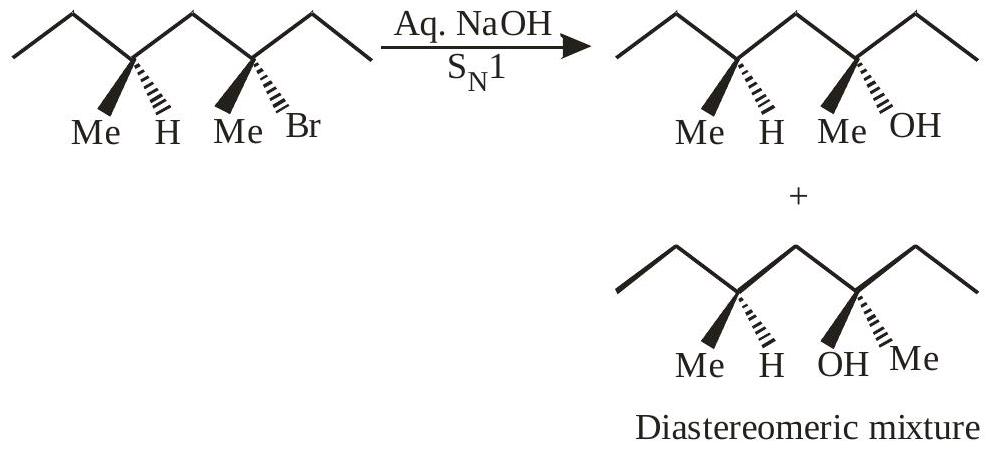
List-II (1) Inversion of configuration (2) Retention of configuration (3) Mixture of enantiomers (4) Mixture of structural isomers (5) Mixture of diastereomersS
(A)P→1;Q→2;R→5;S→3
(B)P→2;Q→1;R→3;S→5✓ Correct
(C)P→1;Q→2;R→5;S→4
(D)P→2;Q→4;R→3;S→5
Answer: (B)
Solution
What happens to the stereocentre depends on *where* the substitution occurs and by *which* mechanism.
(P) (−)-1-Bromo-2-ethylpentane, SN2: the bromine is on C-1 (CH2Br), which is not the stereocentre — the stereocentre is C-2. Substitution at C-1 leaves the bonds at C-2 untouched, so the product keeps its configuration → (2) retention of configuration.
(Q) (−)-2-Bromopentane, SN2: here the bromine sits on the stereocentre (C-2). Back-side attack by OH− inverts it → (1) inversion of configuration.
(R) (−)-3-Bromo-3-methylhexane, SN1: the tertiary bromide ionises to a planar carbocation at the only stereocentre; H2O/OH− attacks either face equally, giving both configurations → (3) mixture of enantiomers (racemisation).
(S) The substrate has two stereocentres: CH(Me) and the tertiary C(Me)(Br). SN1 makes a planar carbocation at the C–Br centre only; attack from both faces gives both configurations there while the other centre is unchanged. Two products differing at one of two stereocentres are → (5) mixture of diastereomers.
P → 2, Q → 1, R → 3, S → 5.
Answer: (B)
JEE Advanced · 2023 · 04 Jun 2023 · Paper 1 · Single correct option