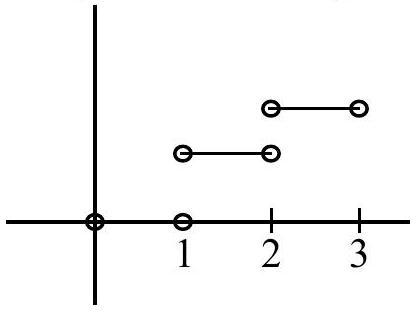
Let S=(0,1)∪(1,2)∪(3,4) and T={0,1,2,3}. Then which of the following statements is(are) true ?
(A)There are infinitely many functions from S to T✓ Correct
(B)There are infinitely many strictly increasing functions from S to T
(C)The number of continuous functions from S to T is at most 120✓ Correct
(D)Every continuous function from S to T is differentiable✓ Correct
Answer: (A), (C), (D)
Solution
Option (A): Each element of S has 4 choices in T. Since S has infinitely many elements, the number of functions is 4n where n→∞, so there are infinitely many functions. (A) is correct.
Option (B): Strictly increasing functions are limited by the discrete nature of T and the disconnected intervals of S. There cannot be infinitely many such functions. (B) is incorrect.
Option (C): For a continuous function from S to T, each of the three disjoint intervals (0,1), (1,2), and (3,4) must map to a constant value in T (since T is discrete). Each interval has 4 choices, giving 4×4×4=64 continuous functions, which is at most 120. (C) is correct.
Option (D): Every continuous function from S to T is piecewise constant (constant on each connected component), hence differentiable everywhere in S (derivative is zero). (D) is correct.
Answer: (A), (C), (D)
JEE Advanced · 2023 · 04 Jun 2023 · Paper 1 · One or more correct options