Consider three sets E1={1,2,3},F1={1,3,4} and G1={2,3,4,5}. Two elements are chosen at random, without replacement, from the set E1, and let S1 denote the set of these chosen elements. Let E2=E1−S1 and F2=F1∪S1. Now two elements are chosen at random, without replacement, from the set F2 and let S2 denote the set of these chosen elements. Let G2=G1∪S2. Finally, two elements are chosen at random, without replacement, from the set G2 and let S3 denote the set of these chosen elements. Let E3=E2∪S3. Given that E1=E3, let p be the conditional probability of the event S1={1,2}. Then the value of p is
(A)51✓ Correct
(B)53
(C)21
(D)52
Answer: (A)
Solution
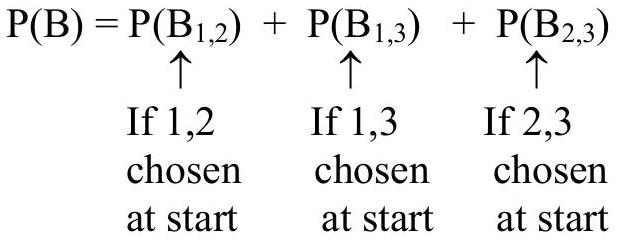
We need P=P(E1=E3)P(S1={1,2}∩(E1=E3))=P(B)P(B1,2). For S1={1,2}: P(B1,2)=31×4C21×3C1×5C21 (1 is definitely chosen from F2, and both 1,2 must be chosen from G2). Similarly compute P(B1,3) and P(B2,3) for the other possible pairs. The total probability P(B)=P(B1,2)+P(B1,3)+P(B2,3). Computing the ratio gives P(B)P(B1,2)=51.
JEE Advanced · 2021 · 03 Oct 2021 · Paper 1 · Single correct option