For any positive integer n, let Sn:(0,∞)→R be defined by Sn(x)=∑k=1ncot−1(x1+k(k+1)x2), where for any x∈R,cot−1x∈(0,π) and tan−1(x)∈(−2π,2π). Then which of the following statements is (are) TRUE?
(A)S10(x)=2π−tan−1(10x1+11x2), for all x>0✓ Correct
(B)limn→∞cot(Sn(x))=x, for all x>0✓ Correct
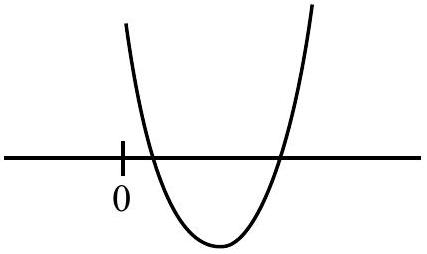
(C)The equation S3(x)=4π has a root in (0,∞)
(D)tan(Sn(x))≤21, for all n≥1 and x>0
Answer: (A), (B)
Solution
Sn(x)=∑k=1ntan−1(1+kx(kx+x)x)=∑k=1ntan−1(1+(k+1)x⋅kx(k+1)x−kx)=tan−1((n+1)x)−tan−1(x)=tan−1(1+(n+1)x2nx). (A) S10(x)=tan−11+11x210x=2π−tan−1(10x1+11x2) for x>0. (B) limn→∞cot(Sn(x))=limn→∞x1+(1+n1)x2=x for x>0. (C) S3(x)=4π gives 1+4x23x=1, so 4x2−3x+1=0, which has no real roots. (D) We need 1+(n+1)x2nx≤21 for all n≥1,x>0, i.e., (n+1)x2−2nx+1≥0. For n=1 this holds, but for n≥2 the discriminant is positive and both roots are positive, so the inequality fails for some x>0.
JEE Advanced · 2021 · 03 Oct 2021 · Paper 1 · One or more correct options