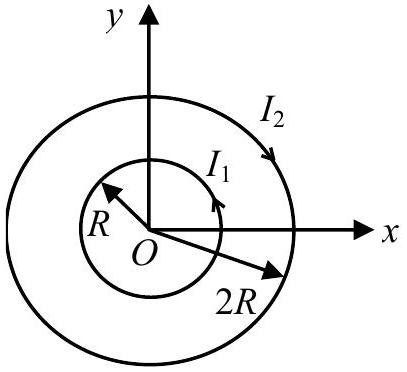
Two concentric circular loops, one of radius R and the other of radius 2R, lie in the xy-plane with the origin as their common center, as shown in the figure. The smaller loop carries current I1 in the anti-clockwise direction and the larger loop carries current I2 in the clockwise direction, with I2>2I1. B(x,y) denotes the magnetic field at a point (x,y) in the xy-plane. Which of the following statement(s) is(are) correct?
(A)B(x,y) is perpendicular to the xy-plane at any point in the plane✓ Correct
(B)∣B(x,y)∣ depends on x and y only through the radial distance r=x2+y2✓ Correct
(C)∣B(x,y)∣ is non-zero at all points for r<R
(D)B(x,y) points normally outward from the xy-plane for all the points between the two loops
Answer: (A), (B)
Solution
Using Biot-Savart law: dB=4πr3μ0idℓ×r
(A) Since both dℓ and r lie in the xy-plane, their cross product dℓ×r is perpendicular to the xy-plane. Therefore B(x,y) is perpendicular to the xy-plane at any point. ✓
(B) Due to circular symmetry about the z-axis, the magnetic field depends only on the radial distance r=x2+y2 from the center. ✓
(C) At the center (r = 0):
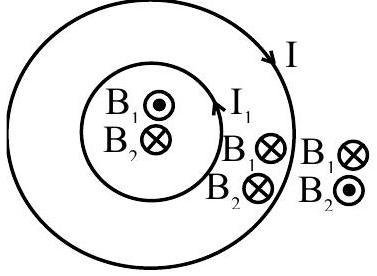
B1=2Rμ0I1 (upward),B2=4Rμ0I2 (downward)
Since I2>2I1, we have B2>B1, so the net field at center points downward.
As we move toward the inner loop, B1 increases (approaching infinity at the wire), while B2 decreases. Therefore, there exists a point between the center and inner loop where B1=B2, making the net field zero. ✗
(D) The direction of B between the loops depends on which field dominates. Since I2>2I1, the field from the outer loop (pointing into the plane by right-hand rule) dominates, so B points into the plane, not outward. ✗
Correct answers: (A) and (B)
JEE Advanced · 2021 · 03 Oct 2021 · Paper 2 · One or more correct options