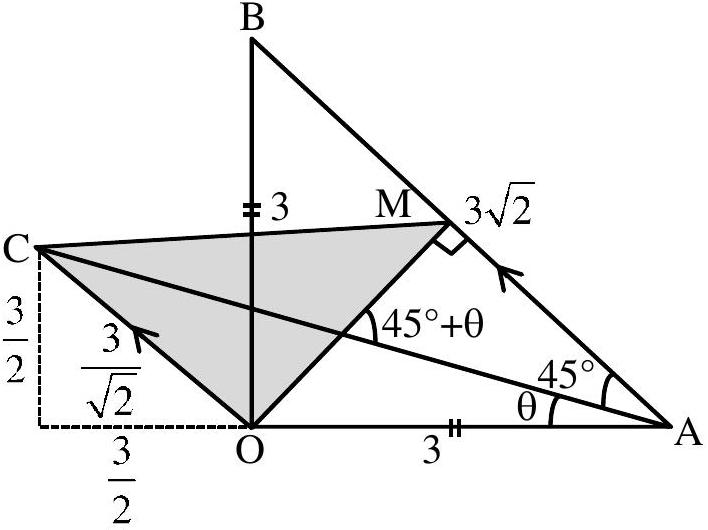
Let O be the origin and OA=2i^+2j^+k^,OB=i^−2j^+2k^ and OC=21(OB−λOA) for some λ>0. If ∣OB×OC∣=29, then which of the following statements is (are) TRUE?
(A)Projection of OC on OA is −23✓ Correct
(B)Area of the triangle OAB is 29✓ Correct
(C)Area of the triangle ABC is 29✓ Correct
(D)The acute angle between the diagonals of the parallelogram with adjacent sides OA and OC is 3π
Answer: (A), (B), (C)
Solution
OB×OC=21OB×(OB−λOA)=2λ(OA×OB).
Note that OA⋅OB=2(1)+2(−2)+1(2)=0, so OA and OB are perpendicular. Thus ∣OA×OB∣=∣OA∣∣OB∣=3×3=9.
From ∣OB×OC∣=29: 2λ×9=29, so λ=1.
Thus OC=21(OB−OA)=21AB, meaning C is the midpoint of AB.
(A) Projection of OC on OA is ∣OA∣OC⋅OA=3−3/2−3/2+1/2=−23. Correct.
(B) Area of triangle OAB = 21∣OA×OB∣=29. Correct.
(C) Since C is the midpoint of AB, triangle ABC has area 21× area of OAB =29. Correct.
(D) The acute angle between diagonals is tan−1(2), not 3π. Incorrect.
Correct answers: (A), (B), (C).
JEE Advanced · 2021 · 03 Oct 2021 · Paper 2 · One or more correct options