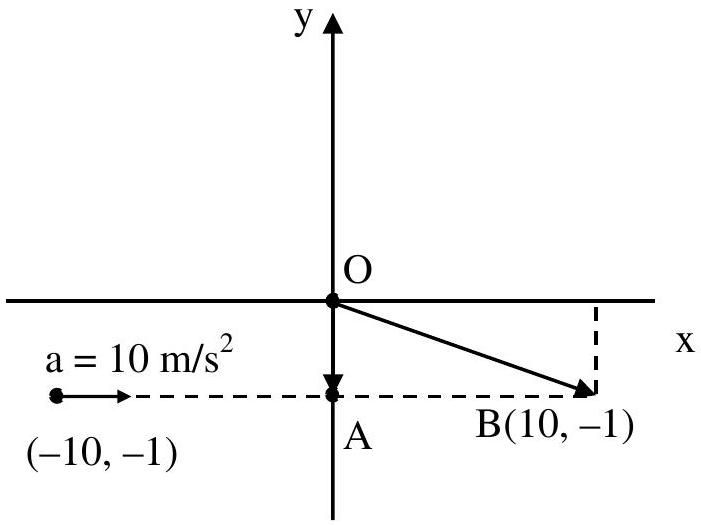
A particle of mass M=0.2 kg is initially at rest in the xy-plane at a point (x=−l,y=−h), where l=10 m and h=1 m. The particle is accelerated at time t=0 with a constant acceleration a=10 m/s2 along the positive x-direction. Its angular momentum and torque with respect to the origin, in SI units, are represented by L and τ, respectively. i^,j^ and k^ are unit vectors along the positive x, y and z-directions, respectively. If k^=i^×j^ then which of the following statement(s) is(are) correct?
(A)The particle arrives at the point (x=l,y=−h) at time t=2 s.✓ Correct
(B)τ=2k^ when the particle passes through the point (x=l,y=−h)✓ Correct
(C)L=4k^ when the particle passes through the point (x=l,y=−h)✓ Correct
(D)τ=k^ when the particle passes through the point (x=0,y=−h)
Answer: (A), (B), (C)
Solution
The particle moves from (−10,−1) to (10,−1), a distance of 20 m.