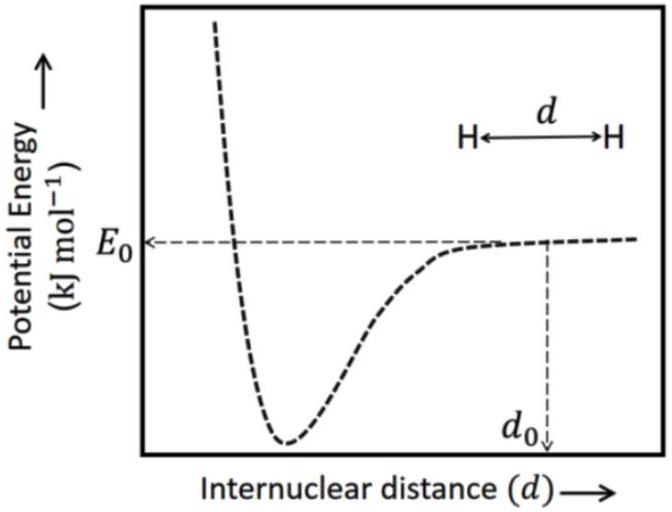
The figure below is the plot of potential energy versus internuclear distance (d) of H2 molecule in the electronic ground state. What is the value of the net potential energy E0 (as indicated in the figure) in kJmol−1, for d=d0 at which the electron-electron repulsion and the nucleus-nucleus repulsion energies are absent? As reference, the potential energy of H atom is taken as zero when its electron and the nucleus are infinitely far apart. Use Avogadro constant as 6.023×10²³mol−1.
Answer: -2630
Solution
At d=d0, nucleus-nucleus and electron-electron repulsions are absent. The potential energy is due to electron-nucleus attraction only for 2 H atoms.
For one H atom (Bohr radius r=0.529×10⁻¹⁰ m):
P.E.=r−kq1q2=0.529×10⁻¹⁰−(9×10⁹)(1.6×10⁻¹⁹)2
=−4.355×10⁻¹⁸ J=−4.355×10⁻²¹ kJ
For 1 mole of H atoms:
=−4.355×10−21×6.023×1023=−2623 kJ/mol
For 2 H atoms (since H₂ has 2 H atoms):
E0=2×(−2623)=−5246 kJ/mol
The source accepts both -2630 (per H atom) and -5260 (for H₂ molecule).