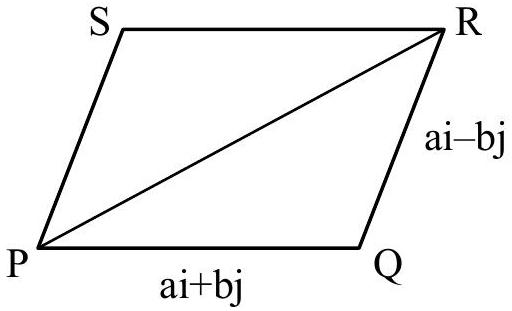
Let a and b be positive real numbers. Suppose PQ=ai^+bj^ and PS=ai^−bj^ are adjacent sides of a parallelogram PQRS. Let u and v be the projection vectors of w=i^+j^ along PQ and PS, respectively. If ∣u∣+∣v∣=∣w∣ and if the area of the parallelogram PQRS is 8, then which of the following statements is/are TRUE?
(A)a+b=4✓ Correct
(B)a−b=2
(C)The length of the diagonal PR of the parallelogram PQRS is 4✓ Correct
(D)w is an angle bisector of the vectors PQ and PS
Answer: (A), (C)
Solution
The projection magnitudes are ∣u∣=a2+b2a+b and ∣v∣=a2+b2∣a−b∣. Given ∣u∣+∣v∣=∣w∣=2, we have a2+b2∣a+b∣+∣a−b∣=2. For a>b, this gives 2a=2a2+b2, leading to a2=b2, so a=b (since both are positive). The area of the parallelogram is ∣PQ×PS∣=2ab=8, so ab=4. With a=b, we get a=b=2, thus a+b=4 (option A). The diagonal PR=PQ+PS=2ai^, so ∣PR∣=4 (option C).
JEE Advanced · 2020 · 27 Sep 2020 · Paper 2 · One or more correct options