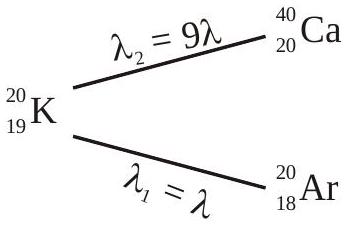
In a radioactive sample, 1940K nuclei either decay into stable 2040Ca nuclei with decay constant 4.5×10⁻¹⁰ per year or into stable 1840Ar nuclei with decay constant 0.5×10⁻¹⁰ per year. Given that in this sample all the stable 2040Ca and 1840Ar nuclei are produced by the 1940K nuclei only. In time t×109 years, if the ratio of the sum of stable 2040Ca and 1840Ar nuclei to the radioactive 1940K nuclei is 99, the value of t will be : [Given ln10=2.3]
(A)9.2✓ Correct
(B)1.15
(C)4.6
(D)2.3
Answer: (A)
Solution
This is a parallel radioactive decay with effective decay constant:
λ=λ1+λ2=4.5×10⁻¹⁰+0.5×10−10=5×10⁻¹⁰ per year
The number of radioactive nuclei: N=N0e−λt
The number of stable nuclei: Nstable=N0−N
Given ratio:
NNstable=NN0−N=NN0−1=99
NN0=100
eλt=100
λt=ln100=2ln10=2×2.3=4.6
t=5×10−104.6=9.2×10⁹ years
JEE Advanced · 2019 · 27 May 2019 · Paper 1 · Single correct option