For a non-zero complex number z, let arg(z) denote the principal argument with −π<arg(z)≤π. Then, which of the following statement(s) is (are) FALSE?
(A)arg(−1−i)=4π, where i=−1✓ Correct
(B)The function f:R→(−π,π], defined by f(t)=arg(−1+it) for all t∈R, is continuous at all points of R, where i=−1✓ Correct
(C)For any two non-zero complex numbers z1 and z2, arg(z2z1)−arg(z1)+arg(z2) is an integer multiple of 2π
(D)For any three given distinct complex numbers z1,z2 and z3, the locus of the point z satisfying the condition arg((z−z3)(z2−z1)(z−z1)(z2−z3))=π, lies on a straight line✓ Correct
Answer: (A), (B), (D)
Solution
(A)arg(−1−i)=4−3π, not 4π. FALSE.
(B)f(t)=arg(−1+it) is discontinuous at t=0. For t>0, f(t)=π−tan−1t; for t<0, f(t)=−π−tan−1t. The left and right limits at t=0 differ by 2π. FALSE.
(C) This is TRUE by the property of arguments: arg(z1/z2)=arg(z1)−arg(z2)+2kπ for some integer k.
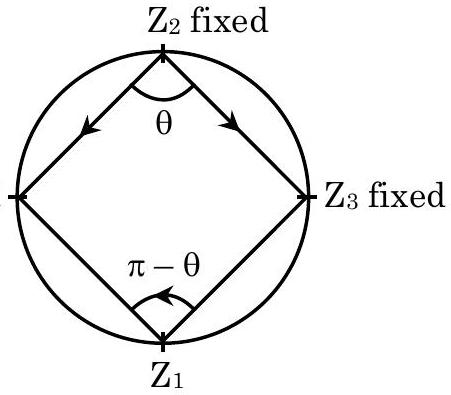
(D) The condition arg((z−z3)(z2−z1)(z−z1)(z2−z3))=π means arg(z−z3z−z1)=π−θ where θ=arg(z2−z1z2−z3). This describes a circular arc (part of the circumcircle of △z1z2z3), not a straight line. FALSE.
JEE Advanced · 2018 · 20 May 2018 · Paper 1 · One or more correct options