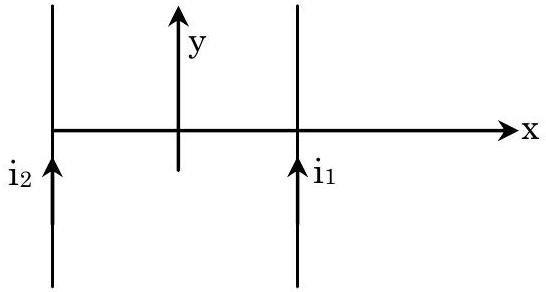
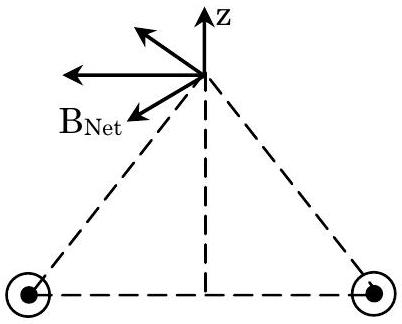
Two infinitely long straight wires lie in the xy-plane along the lines x=±R. The wire located at x=+R carries a constant current I1 and the wire located at x=−R carries a constant current I2. A circular loop of radius R is suspended with its centre at (0,0,3R) and in a plane parallel to the xy-plane. This loop carries a constant current I in the clockwise direction as seen from above the loop. The current in the wire is taken to be positive if it is in the +^ direction. Which of the following statements regarding the magnetic field B is (are) true?
(A)If I1=I2, then B cannot be equal to zero at the origin (0,0,0)✓ Correct
(B)If I1>0 and I2<0, then B can be equal to zero at the origin (0,0,0)✓ Correct
(C)If I1<0 and I2>0, then B can be equal to zero at the origin (0,0,0)
(D)If I1=I2, then the z-component of the magnetic field at the centre of the loop is (−2Rμ0I)✓ Correct
Answer: (A), (B), (D)
Solution
(A) If I1=I2, the fields from the two wires cancel at the origin, but the loop's field persists, so B=0 — correct. (B) If I1>0 and I2<0, both wires and the loop contribute fields in the same direction, so B can be zero by adjusting magnitudes — correct. (C) If I1<0 and I2>0, the wire fields and loop field are all in the same direction, so B cannot be zero — incorrect. (D) If I1=I2, the wire contributions cancel, leaving only the loop's field at its center: Bz=−2Rμ0I — correct.
JEE Advanced · 2018 · 20 May 2018 · Paper 1 · One or more correct options