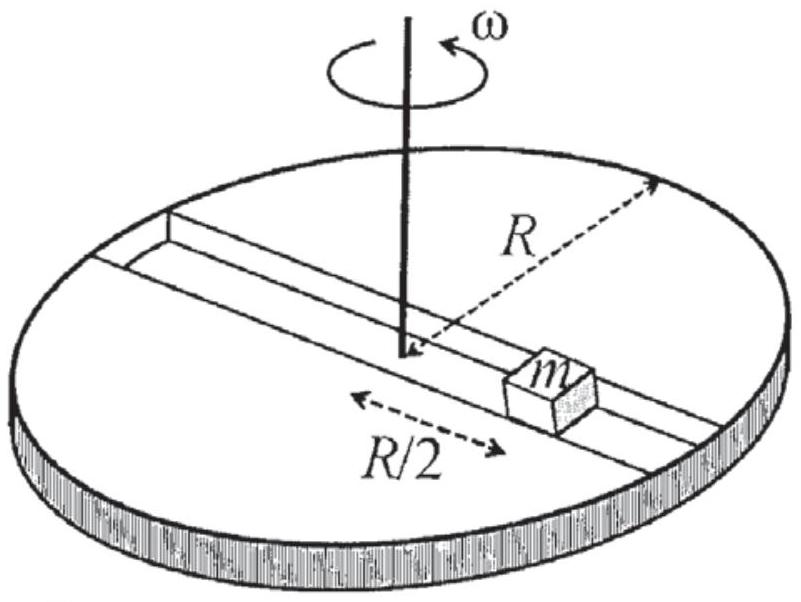
A frame of reference that is accelerated with respect to an inertial frame of reference is called a non-inertial frame of reference. A coordinate system fixed on a circular disc rotating about a fixed axis with a constant angular velocity ω is an example of a non-inertial frame of reference. The relationship between the force Frot experienced by a particle of mass m moving on the rotating disc and the force Fin experienced by the particle in an inertial frame of reference is
Frot=Fin+2m(vrot×ω)+m(ω×r)×ω,
where vrot is the velocity of the particle in the rotating frame of reference and r is the position vector of the particle with respect to the centre of the disc. Now consider a smooth slot along a diameter of a disc of radius R rotating counter-clockwise with a constant angular speed ω about its vertical axis through its center. We assign a coordinate system with the origin at the center of the disc, the x-axis along the slot, the y-axis perpendicular to the slot and the z-axis along the rotation axis (ω=ωk^). A small block of mass m is gently placed in the slot at r=(R/2)i^ at t=0 and is constrained to move only along the slot.
PARAGRAPH 1
A frame of reference that is accelerated with respect to an inertial frame of reference is called a non-inertial frame of reference. A coordinate system fixed on a circular disc rotating about a fixed axis with a constant angular velocity ω is an example of a non-inertial frame of reference. The relationship between the force Frot experienced by a particle of mass m moving on the rotating disc and the force Fin experienced by the particle in an inertial frame of reference is
Frot=Fin+2m(vrot×ω)+m(ω×r)×ω,
where vrot is the velocity of the particle in the rotating frame of reference and r is the position vector of the particle with respect to the centre of the disc.
Now consider a smooth slot along a diameter of a disc of radius R rotating counter-clockwise with a constant angular speed ω about its vertical axis through its center. We assign a coordinate system with the origin at the center of the disc, the x-axis along the slot, the y-axis perpendicular to the slot and the z-axis along the rotation axis (ω=ωk^). A small block of mass m is gently placed in the slot at r=(R/2)i^ at t=0 and is constrained to move only along the slot.
The net reaction of the disc on the block is
(A)21mω2R(e2ωt−e−2ωt)j^+mgk^
(B)21mω2R(eωt−e−ωt)j^+mgk^✓ Correct
(C)−mω2Rcosωtj^−mgk^
(D)mω2Rsinωtj^−mgk^
Answer: (B)
Solution
The pseudo-force in the rotating frame is: Frot=2m(vrot×ω)=−2mvrotωj^
where vrot=dtdr=4ωR(eωt−e−ωt)
So Frot=−2mω2R(eωt−e−ωt)j^
The net reaction from the disc must balance this Coriolis force plus provide the normal force against gravity:
Fnet=−Frot+mgk^=2mω2R(eωt−e−ωt)j^+mgk^
JEE Advanced · 2016 · 22 May 2016 · Paper 2 · Single correct option