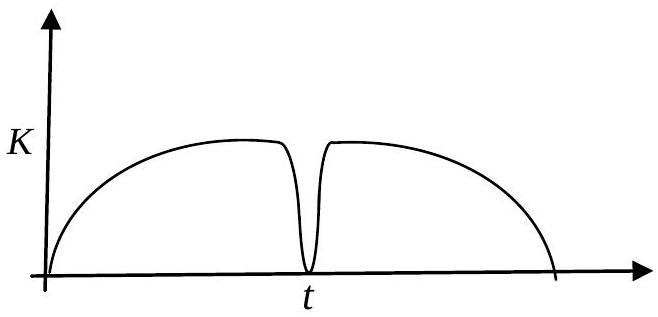
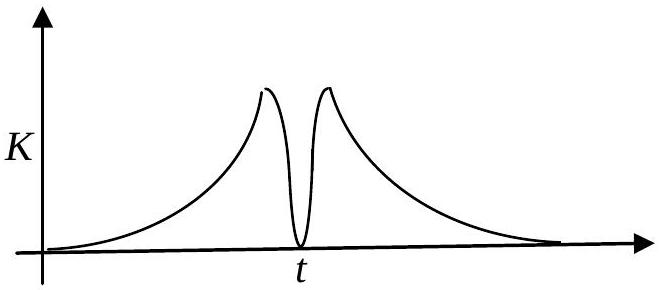
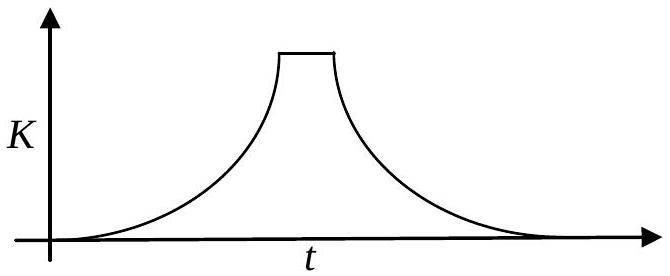
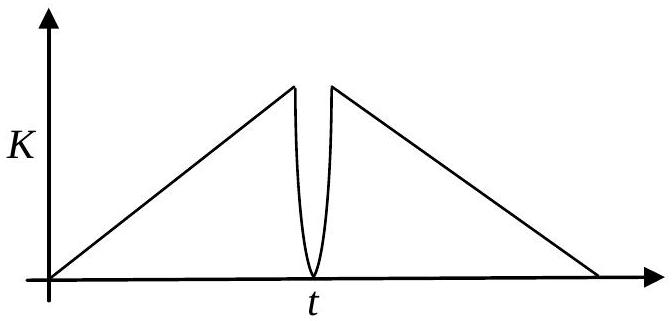
A tennis ball is dropped on a horizontal smooth surface. It bounces back to its original position after hitting the surface. The force on the ball during the collision is proportional to the length of compression of the ball. Which one of the following sketches describes the variation of its kinetic energy K with time t most appropriately? The figures are only illustrative and not to the scale.
(A)(see structure)
(B)(see structure)✓ Correct
(C)(see structure)
(D)(see structure)
Answer: (B)
Solution
During free fall before collision, the ball's kinetic energy increases as K=21mv2=21mg2t2, following a parabolic path. During collision, the force is proportional to compression (spring-like behavior), so the ball undergoes simple harmonic motion. The kinetic energy varies as K=Kmaxcos2(ωt), which is a smooth oscillation between maximum and zero. After bouncing, the kinetic energy again follows a parabolic decrease as the ball rises. Option (B) correctly shows this behavior: parabolic increase, smooth oscillatory variation during collision, and parabolic decrease after bounce.
JEE Advanced · 2014 · 25 May 2014 · Paper 2 · Single correct option