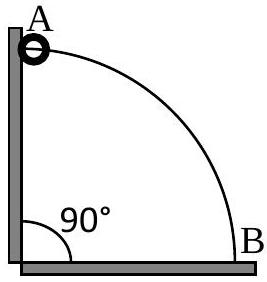
A wire, which passes through the hole in a small bead, is bent in the form of quarter of a circle. The wire is fixed vertically on ground as shown in the figure. The bead is released from near the top of the wire and it slides along the wire without friction. As the bead moves from A to B, the force it applies on the wire is
(A)always radially outwards.
(B)always radially inwards.
(C)radially outwards initially and radially inwards later.
(D)radially inwards initially and radially outwards later.✓ Correct
Answer: (D)
Solution
Using energy conservation: mgR(1−cosθ)=21mv2, so Rmv2=2mg(1−cosθ).
The normal force is N=mgcosθ−Rmv2=mgcosθ−2mg(1−cosθ)=3mgcosθ−2mg=3mg(cosθ−32).
When cosθ>32 (initially, near the top), N>0, meaning the wire pushes the bead radially outward, so the bead pushes the wire radially inward.
When cosθ<32 (later, near the bottom), N<0, meaning the wire pulls the bead radially inward, so the bead pushes the wire radially outward.
Therefore, the force is radially inwards initially and radially outwards later.
JEE Advanced · 2014 · 25 May 2014 · Paper 2 · Single correct option