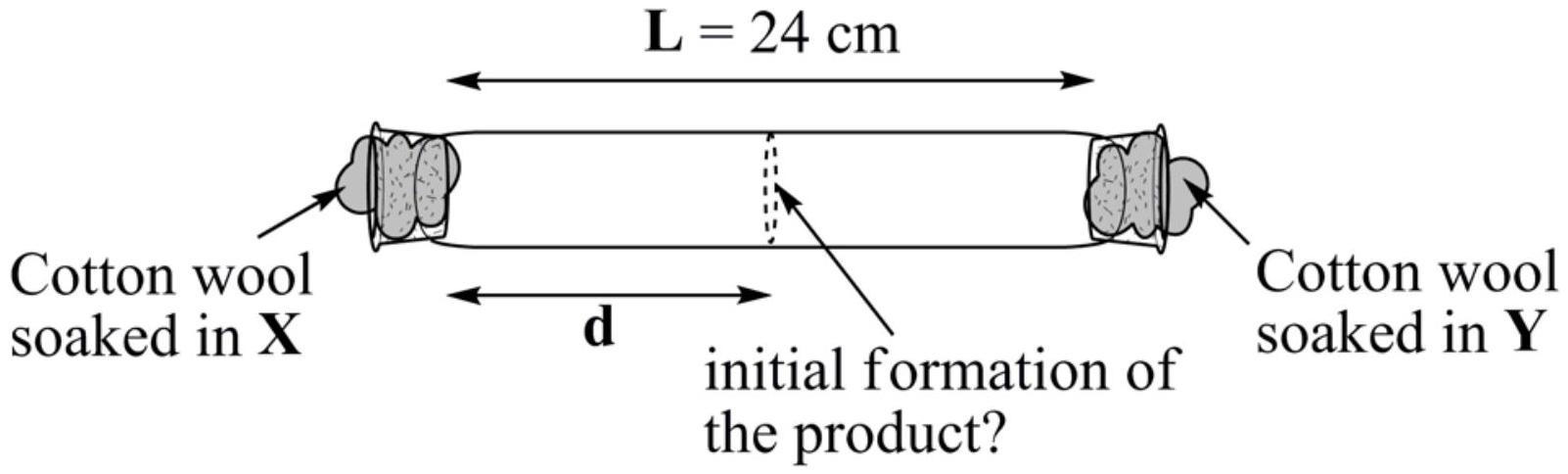
X and Y are two volatile liquids with molar weights of 10gmol−1 and 40gmol−1 respectively. Two cotton plugs, one soaked in X and the other soaked in Y, are simultaneously placed at the ends of a tube of length L=24cm, as shown in the figure. The tube is filled with an inert gas at 1 atmosphere pressure and a temperature of 300 K. Vapours of X and Y react to form a product which is first observed at a distance d cm from the plug soaked in X. Take X and Y to have equal molecular diameters and assume ideal behaviour for the inert gas and the two vapours.
The experimental value of d is found to be smaller than the estimate obtained using Graham's law. This is due to
(A)larger mean free path for X as compared to that of Y.
(B)larger mean free path for Y as compared to that of X.
(C)increased collision frequency of Y with the inert gas as compared to that of X with the inert gas.
(D)increased collision frequency of X with the inert gas as compared to that of Y with the inert gas.✓ Correct
Answer: (D)
Solution
Graham's law assumes no collisions between gas molecules. In reality, molecules collide with each other and with the inert gas.
Molecule X is lighter (lower molar mass) and moves faster, so it has a higher collision frequency with the inert gas molecules compared to the heavier, slower molecule Y. These collisions slow down X more than Y is slowed down.
As a result, X doesn't travel as far as Graham's law predicts, making the experimental value of d smaller than the theoretical estimate.
The mean free path is inversely related to collision frequency. X has a smaller mean free path (more collisions) compared to Y.
Therefore, the correct answer is (D): increased collision frequency of X with the inert gas compared to that of Y.
JEE Advanced · 2014 · 25 May 2014 · Paper 2 · Single correct option