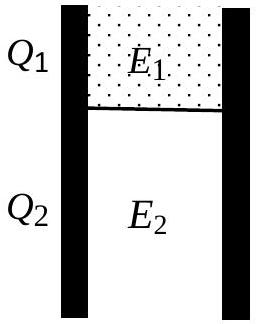
A parallel plate capacitor has a dielectric slab of dielectric constant K between its plates that covers 1/3 of the area of its plates, as shown in the figure. The total capacitance of the capacitor is C while that of the portion with dielectric in between is C1. When the capacitor is charged, the plate area covered by the dielectric gets charge Q1 and the rest of the area gets charge Q2. The electric field in the dielectric is E1 and that in the other portion is E2. Choose the correct option/options, ignoring edge effects.
(A)E2E1=1✓ Correct
(B)E2E1=K1
(C)Q2Q1=K3
(D)C1C=K2+K✓ Correct
Answer: (A), (D)
Solution
The capacitor is effectively two capacitors in parallel: one with dielectric (area A/3, capacitance C1=Kdε0A/3) and one without (area 2A/3, capacitance C2=dε0(2A/3)).
Let c=3dε0A. Then C1=Kc and C2=2c. Total: C=C1+C2=(K+2)c, so c=K+2C.
Thus C1=K+2KC, giving C1C=KK+2=K2+K. So (D) is correct.
Both portions are at the same potential difference V (parallel connection). Electric field E=dV is the same in both regions, so E2E1=1. So (A) is correct.
Charges: Q1=C1V and Q2=C2V, so Q2Q1=C2C1=2cKc=2K, not K3. So (C) is wrong.
Option (B) is wrong since E1=E2.
JEE Advanced · 2014 · 25 May 2014 · Paper 1 · One or more correct options