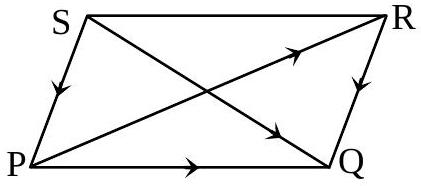
Let PR=3i^+j^−2k^ and SQ=i^−3j^−4k^ determine diagonals of a parallelogram PQRS and PT=i^+2j^+3k^ be another vector. Then the volume of the parallelepiped determined by the vectors PT,PQ and PS is
(A)5
(B)20
(C)10✓ Correct
(D)30
Answer: (C)
Solution
For a parallelogram with diagonals PR and SQ, we have PQ+QR=PR and PQ−QR=SQ. Adding: 2PQ=PR+SQ=(3i^+j^−2k^)+(i^−3j^−4k^)=4i^−2j^−6k^, so PQ=2i^−j^−3k^. Subtracting: 2QR=PR−SQ=2i^+4j^+2k^, so QR=i^+2j^+k^=PS. The volume is ∣PT⋅(PQ×PS)∣=1212−123−31=∣1(−1+6)−2(2+3)+3(4+1)∣=∣5−10+15∣=10.
JEE Advanced · 2013 · 02 Jun 2013 · Paper 1 · Single correct option