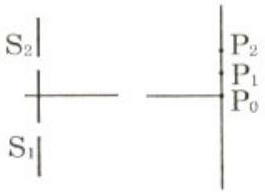
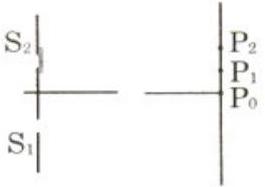
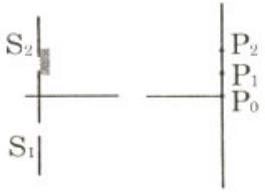
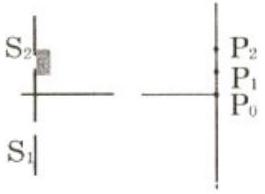
Column I shows four situations of standard Young's double slit arrangement with the screen placed far away from the slits S1 and S2. In each of these cases S1P0=S2P0,S1P1−S2P1=λ/4 and S1P2−S2P2=λ/3, where λ is the wavelength of the light used. In the cases B, C and D, a transparent sheet of refractive index μ and thickness t is pasted on slit S2. The thicknesses of the sheets are different in different cases. The phase difference between the light waves reaching a point P on the screen from the two slits is denoted by δ(P) and the intensity by I(P). Match each situation given in Column I with the statement(s) in Column II valid for that situation.
Column I (A) (see structure) (B) (μ−1)t=λ/4 (see structure) (C) (μ−1)t=λ/2 (see structure) (D) (μ−1)t=3λ/4 (see structure)
Column II (p) δ(P0)=0 (q) δ(P1)=0 (r) I(P1)=0 (s) I(P0)>I(P1) (t) I(P2)>I(P1)ABCD
Answer: A → I, A → IV, B → II, C → V, D → III, D → IV, D → V
Solution
The sheet introduces an additional path difference of (μ−1)t. For case A (no sheet): δ(P0)=0 (p), and I(P0) is maximum while I(P1) is less (s). For case B: the sheet compensates the path difference at P1, making δ(P1)=0 (q). For case C: the sheet adds λ/2, making P2 brighter than P1 (t). For case D: the sheet adds 3λ/4, making P1 a minimum (r), P0 brighter than P1 (s), and P2 brighter than P1 (t).
JEE Advanced · 2009 · 12 Apr 2009 · Paper 2 · Match the columns