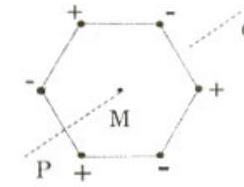
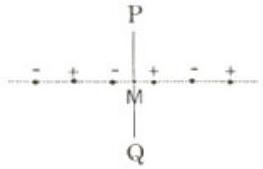
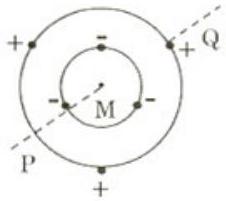
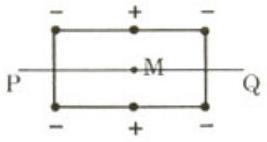
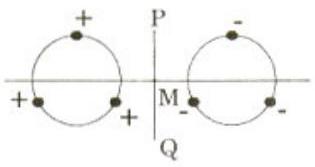
Six point charges, each of the same magnitude q, are arranged in different manners as shown in Column II. In each case, a point M and a line PQ passing through M are shown. Let E be the electric field and V be the electric potential at M (potential at infinity is zero) due to the given charge distribution when it is at rest. Now, the whole system is set into rotation with a constant angular velocity about the line PQ. Let B be the magnetic field at M and μ be the magnetic moment of the system in this condition. Assume each rotating charge to be equivalent to a steady current.
Column I
Column II
(A)
E=0
(p)
(see structure)
(B)
V=0
(q)
(see structure)
(C)
B=0
(r)
(see structure)
(D)
μ=0
(s)
(see structure)
(t)
(see structure)
pqrst
Answer: A → I, A → III, A → IV, B → III, B → IV, C → I, C → II, C → V, D → III, D → IV
Solution
For each configuration, we analyze the symmetry. (A) E=0 when charges are symmetrically placed around M: (p) hexagon center, (r) common center of rings, (s) rectangle center. (B) V=0 when charges are present: (r) and (s) have charges at finite distances. (C) B=0 when the magnetic field contributions cancel: (p) hexagon symmetry, (q) linear arrangement perpendicular to PQ, (t) two rings with M at midpoint. (D) μ=0 when there is net circulation: (r) and (s) have non-zero magnetic moments.
JEE Advanced · 2009 · 12 Apr 2009 · Paper 1 · Match the columns