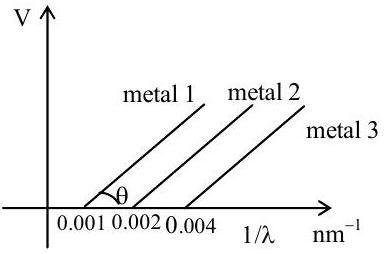
The graph between 1/λ and stopping potential (V) of three metals having work functions ϕ1,ϕ2 and ϕ3 in an experiment of photo-electric effect is plotted as shown in the figure. Which of the following statement(s) is/are correct? [Here λ is the wavelength of the incident ray].
(A)Ratio of work functions ϕ1:ϕ2:ϕ3=1:2:4✓ Correct
(B)Ratio of work functions ϕ1:ϕ2:ϕ3=4:2:1
(C)tanθ is directly proportional to hc/e, where h is Planck's constant and c is the speed of light.✓ Correct
(D)The violet colour light can eject photoelectrons from metals 2 and 3.
Answer: (A), (C)
Solution
From Einstein's photoelectric equation: λhc−ϕ=eV, which gives V=eλhc−eϕ or V=ehc⋅λ1−eϕ.
This is a linear relation between V and 1/λ with slope tanθ=ehc (same for all metals) and y-intercept −eϕ.
From the graph, the x-intercepts (where V=0) give λ01=hcϕ. Reading from the graph: for metal 1, hcϕ1=0.001; for metal 2, hcϕ2=0.002; for metal 3, hcϕ3=0.004. Therefore ϕ1:ϕ2:ϕ3=1:2:4 (option A correct, B incorrect).
The slope tanθ=ehc is directly proportional to hc/e (option C correct).
For metal 2: λ0=ϕ2hc=0.0021=500 nm. For metal 3: λ0=0.0041=250 nm. Violet light has λ≈400 nm. Since λviolet<λ0 for metal 2 (400 < 500), photoelectrons will be ejected from metal 2. But λviolet>λ0 for metal 3 (400 > 250), so no photoelectrons from metal 3 (option D incorrect).
JEE Advanced · 2006 · 09 Apr 2006 · One or more correct options