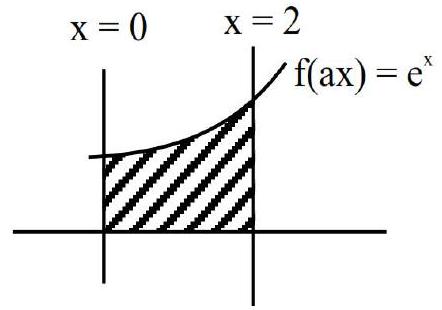
Let f:R→R be a twice differentiable function such that f(x+y)=f(x)f(y) for all x,y∈R. If f′(0)=4a and f satisfies f′′(x)−3af′(x)−f(x)=0, a>0, then the area of the region R={(x,y)∣0≤y≤f(ax),0≤x≤2} is :
(A)e2−1✓ Correct
(B)e4+1
(C)e4−1
(D)e2+1
Answer: (A)
Solution
Since f(x+y)=f(x)f(y) for all real x,y, setting x=y=0 gives f(0)=f(0)2, so f(0)=0 or f(0)=1. If f(0)=0 then f(x)=f(x)f(0)=0 for every x, which would force f′(0)=0=4a since a>0; so f(0)=1.
A differentiable solution of this functional equation is exponential: f(x)=eλx for some constant λ. Then f′(x)=λeλx, and f′(0)=λ=4a, so
f(x)=e4ax.
Substitute into f′′(x)−3af′(x)−f(x)=0. Since f′′(x)=λ2eλx,
λ2−3aλ−1=0⟹(4a)2−3a(4a)−1=0⟹16a2−12a2−1=0⟹4a2=1.
As a>0, a=21.
So f(x)=e4⋅21x=e2x, and f(ax)=f(2x)=e2⋅x/2=ex.
The region is R={(x,y):0≤y≤ex,0≤x≤2}, whose area is
∫02exdx=e2−1.
JEE Main · 2025 · 22 Jan 2025 · Shift 1 · Single correct option