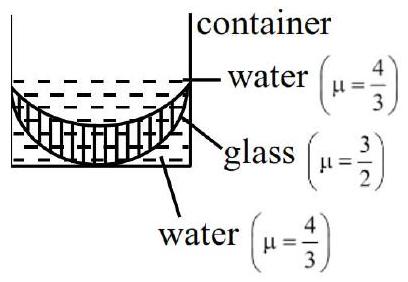
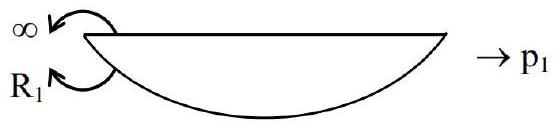
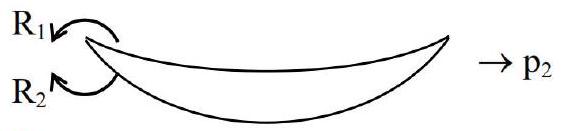
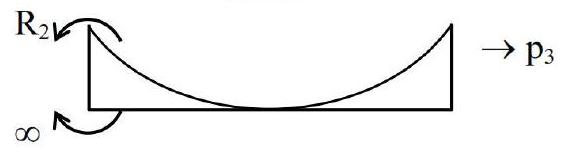
In the diagram given below, there are three lenses formed. Considering negligible thickness of each of them as compared to [R1] and [R2], i.e., the radii of curvature for upper and lower surfaces of the glass lens, the power of the combination is
(A)−61(∣R1∣1+∣R2∣1)
(B)−61(∣R1∣1−∣R2∣1)✓ Correct
(C)61(∣R1∣1+∣R2∣1)
(D)61(∣R1∣1−∣R2∣1)
Answer: (B)
Solution
Model the water–glass–water sandwich as three refracting surfaces in series and use the power of a single curved surface, P=(μ−1)(v1−u1), applied at each surface.
Surface 1 – top curved face of the water layer, radius R1 (water, μ=4/3):
P1=(34−1)(∞1−−∣R1∣1)=3∣R1∣1.
Surface 2 – the glass lens (μ=3/2) bounded by R1 above and R2 below: