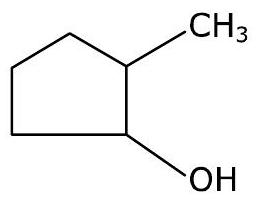
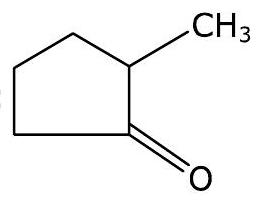
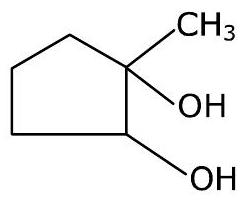
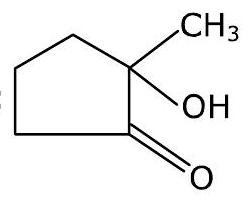
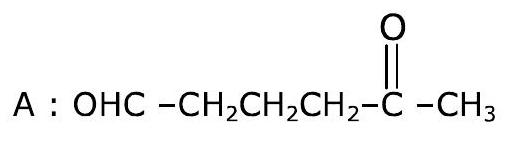
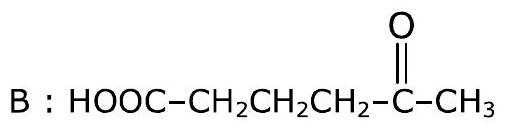
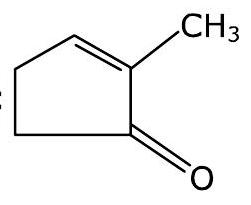
The reaction shown involves the ozonolysis of a cyclic alkene followed by reductive workup.
In the first step, ozone (OX3) adds across the double bond to form a molozonide, which rearranges to an ozonide. The reductive workup with Zn/HX2O cleaves the ozonide to give carbonyl compounds.
For the given cyclic structure with a methyl substituent, ozonolysis cleaves the ring at the double bond. The reductive workup produces:
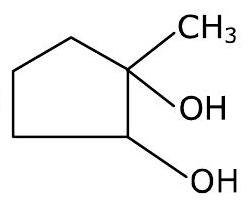
Product A: A cyclic diol (1-methylcyclopentane-1,2-diol) where both carbons of the former double bond are converted to hydroxyl groups.
Product B: A cyclic ketone-alcohol (2-methylcyclopentanone with a hydroxyl group).
Based on the mechanism and the structures shown in option (2), where A shows the gem-diol structure and B shows the keto-alcohol structure, option (2) is correct.
JEE Main · 2021 · 24 Feb 2021 · Shift 1 · Single correct option