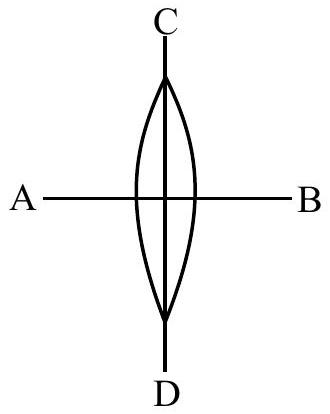
A symmetric thin biconvex lens is cut into four equal parts by two planes AB and CD as shown in figure. If the power of original lens is 4D then the power of a part of the divided lens is
(A)8 D
(B)4 D
(C)D
(D)2 D✓ Correct
Answer: (D)
Solution
For a thin biconvex lens with both faces of radius of curvature R, the lens maker's formula gives f1=(μ−1)(R1+R1)=(μ−1)R2 so the power of the whole lens is P=(μ−1)R2=4 D.
The plane CD (perpendicular to the optical axis, through the centre) splits the lens along its thickness into a front piece and a back piece. Each of these is no longer biconvex but plano-convex, with only one curved surface of radius R and a flat face at the cut: f′1=(μ−1)R1 which is exactly half of the biconvex expression, so its power is P′=2P.
The plane AB (containing the axis) further splits each plano-convex piece by aperture only — this changes the size of the piece but not the radius of curvature of its curved surface, so the power is unaffected by this second cut.
Hence each of the four pieces has power P′=24=2 D
JEE Main · 2025 · 22 Jan 2025 · Shift 2 · Single correct option