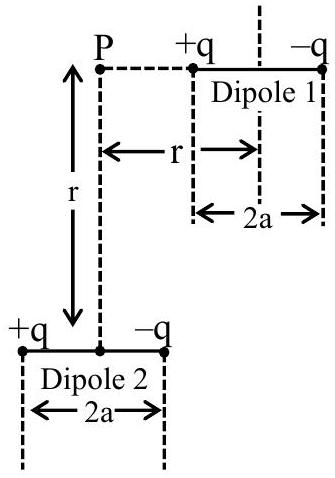
A point particle of charge Q is located at P along the axis of an electric dipole 1 at a distance r as shown in the figure. The point P is also on the equatorial plane of a second electric dipole 2 at a distance r . The dipoles are made of opposite charge q separated by a distance 2a. For the charge particle at P not to experience any net force, which of the following correctly describes the situation?
(A)ra−20
(B)ra∼10
(C)ra∼0.5
(D)ra∼3✓ Correct
Answer: (D)
Solution
Charge Q at point P sits on the axis of dipole 1 (charges ±q separated by 2a) at distance r, and simultaneously on the equatorial line of dipole 2 (same charges, same separation) at the same distance r. For Q to feel zero net force, the axial field of dipole 1 at P must exactly cancel the equatorial field of dipole 2 at P.
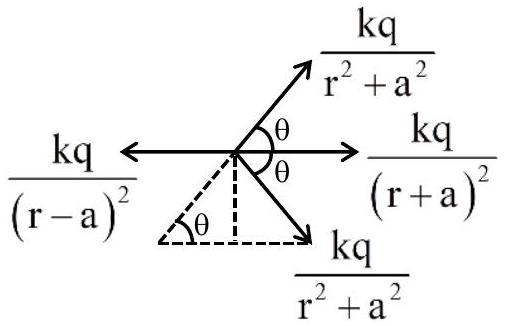
Field on the axis of dipole 1, from the two point charges directly at distances r−a and r+a:
Eaxial=(r−a)2kq−(r+a)2kq=(r2−a2)24kqra
Field on the equatorial line of dipole 2, from the two charges each at distance r2+a2, components along the axis adding:
Eequatorial=(r2+a2)3/22kqa
Setting these equal for force balance:
(r2−a2)24kqra=(r2+a2)3/22kqa
4r2(r2+a2)3=(r2−a2)4
This relation between a and r has no clean closed-form solution; solving it numerically gives
ra≈3
JEE Main · 2025 · 23 Jan 2025 · Shift 1 · Single correct option