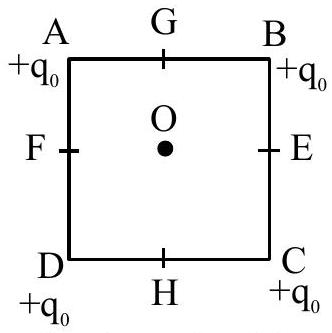
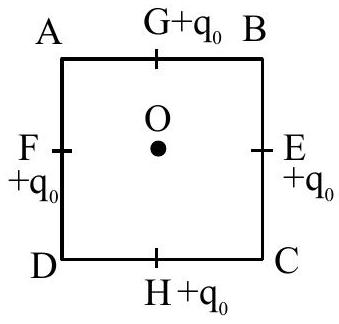
In the first configuration (1) as shown in the figure, four identical charges ( q0 ) are kept at the corners A,B,C and D of square of side length ' a '. In the second configuration (2), the same charges are shifted to mid points G,E,H and F , of the square, If K=4πε01, the difference between the potential energies of configuration (2) and (1) is given by :Configuration(1)Configuration(2)
(A)aKq02(42−2)
(B)aKq02(3−2)
(C)aKq02(4−22)
(D)aKq02(32−2)✓ Correct
Answer: (D)
Solution
Configuration 1: four equal charges q0 sit at the corners of a square of side a. There are 4 nearest-neighbour pairs at distance a and 2 diagonal pairs at distance a2:
U1=4⋅aKq02+2⋅a2Kq02=aKq02(4+2).
Configuration 2: the charges move to the midpoints of the sides, forming a smaller square (rotated 45°) of side 2a. Again there are 4 nearest-neighbour pairs, now at distance 2a, and 2 diagonal pairs at distance equal to the diagonal of this smaller square, which is a:
U2=4⋅a/2Kq02+2⋅aKq02=aKq02(42+2).
The difference is
U2−U1=aKq02[(42+2)−(4+2)]=aKq02(32−2).
JEE Main · 2025 · 24 Jan 2025 · Shift 2 · Single correct option