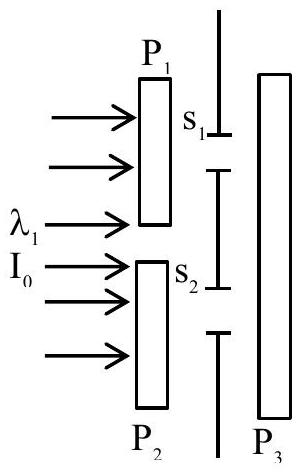
In a Young's double slit experiment, three polarizers are kept as shown in the figure. The transmission axes of P1 and P2 are orthogonal to each other. The polarizer P3 covers both the slits with its transmission axis at 45∘ to those of P1 and P2. An unpolarized light of wavelength λ and intensity I0 is incident on P1 and P2. The intensity at a point after P3 where the path difference between the light waves from s1 and s2 is 3λ, is
(A)2I0
(B)4I0✓ Correct
(C)I0
(D)3I0
Answer: (B)
Solution
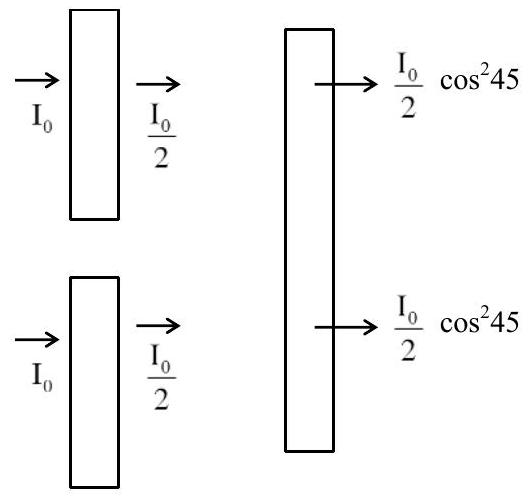
Unpolarized light of intensity I0 falls on P1 (covering slit S1) and on P2 (covering slit S2), with P1⊥P2. Passing unpolarized light through a polarizer always halves its intensity, so the light reaching each slit has intensity
I1=I2=2I0,
and the two beams are polarized along mutually perpendicular directions (along P1 and P2 respectively).
Both beams then pass through P3, whose transmission axis is at 45∘ to both P1 and P2. By Malus's law, each beam is attenuated by cos2(45∘)=21:
I1′=I2′=2I0×21=4I0.
After P3 both beams share the same polarization direction, so they can now interfere at the screen. At the point where the path difference is λ/3, the phase difference is
Δϕ=λ2π⋅3λ=32π.
With equal component intensities I1′=I2′=I0/4, the resultant intensity is