Let A={x∈(0,π)−{2π}:log(2/π)∣sinx∣+log(2/π)∣cosx∣=2} and B={x≥0:x(x−4)−3∣x−2∣+6=0}. Then n(A∪B) is equal to:
(A)4
(B)2
(C)8✓ Correct
(D)6
Answer: (C)
Solution
For set A: log2/π∣sinx∣+log2/π∣cosx∣=2 means log2/π(∣sinxcosx∣)=2, i.e.
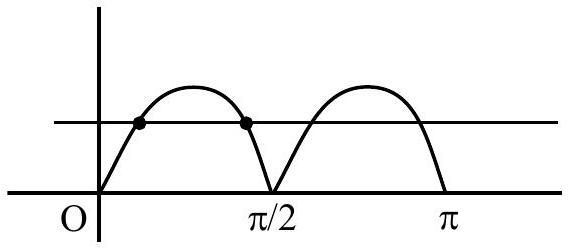
∣sinxcosx∣=(π2)2⇒2∣sin2x∣=π24⇒∣sin2x∣=π28.
Since 0<π28<1, this is solvable. For x∈(0,π)−{2π}, 2x ranges over (0,2π)−{π}. The equation ∣sin2x∣=k for 0<k<1 has exactly 4 solutions in a full period (0,2π) (two where sin2x=k>0 and two where sin2x=−k), and none of these coincide with 2x=π (where sin2x=0=k). So ∣A∣=4.
For set B: let t=x≥0, so the equation is t(t−4)−3∣t−2∣+6=0.
For t<2: ∣t−2∣=2−t, giving t2−4t−3(2−t)+6=0⇒t2−t=0⇒t=0 or t=1, both valid (i.e. x=0,1).
For t≥2: ∣t−2∣=t−2, giving t2−4t−3(t−2)+6=0⇒t2−7t+12=0⇒t=3 or t=4, both valid (i.e. x=9,16).
So B={0,1,9,16}, ∣B∣=4.
Since A consists of transcendental values of x in (0,π) (from sin2x=±8/π2) that don't coincide with the integers {0,1,9,16} (and 9,16>π in any case), A and B are disjoint. So
n(A∪B)=4+4=8.
Graph showing solutions of |sin 2x| = 8/π²
JEE Main · 2025 · 24 Jan 2025 · Shift 2 · Single correct option