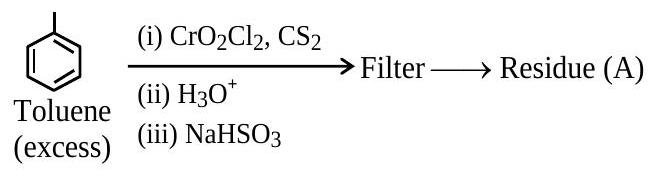
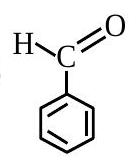
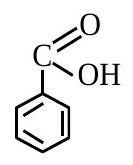
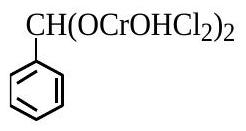
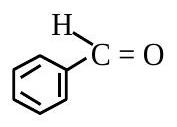
Structure of residue (A) and compound (B) formed respectively is :
(A)(see structures)AB
(B)(see structures)AB
(C)(see structures)AB
(D)(see structures)AB✓ Correct
Answer: (D)
Solution
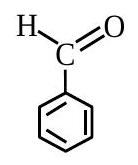
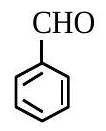
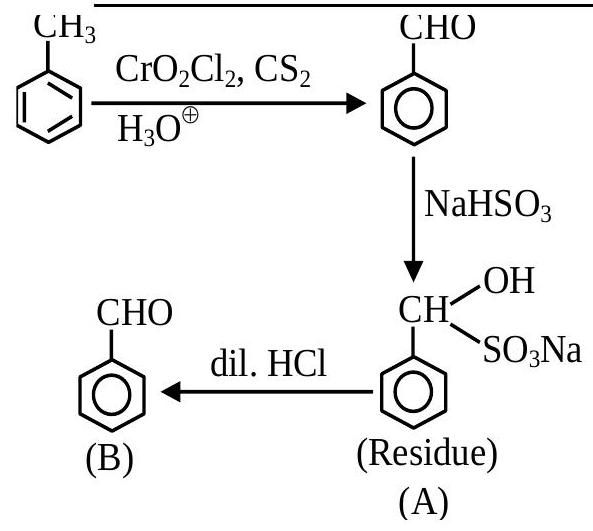
Toluene, treated with chromyl chloride (CrO2Cl2) in CS2 and then hydrolyzed with H3O+, undergoes the Etard reaction: the methyl side chain is oxidized directly to an aldehyde, giving benzaldehyde, C6H5CHO.
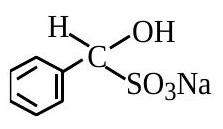
Benzaldehyde then reacts with NaHSO3: the bisulfite ion adds across the carbonyl carbon in a nucleophilic addition, forming the crystalline bisulfite addition compound C6H5CH(OH)SO3Na, which separates out as the residue (A).
Treating this bisulfite adduct (residue A) with dilute HCl reverses the addition — protonation and loss of SO2 pull the equilibrium back — regenerating free benzaldehyde as compound (B):
C6H5CH(OH)SO3Na+HCl⟶C6H5CHO+NaCl+H2O+SO2
Residue (A) is the benzaldehyde–sodium bisulfite adduct C6H5CH(OH)SO3Na, and compound (B) is benzaldehyde, C6H5CHO.
JEE Main · 2025 · 22 Jan 2025 · Shift 2 · Single correct option