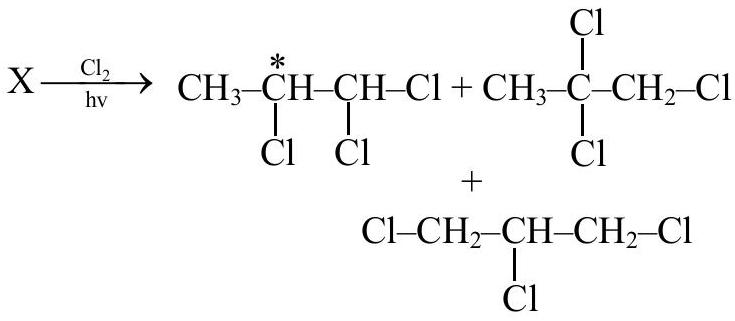
Propane molecule on chlorination under photochemical condition gives two di-chloro products, " x " and " y ". Amongst " x " and " y ", " x " is an optically active molecule. How many tri-chloro products (consider only structural isomers) will be obtained from "x" when it is further treated with chlorine under the photochemical condition?
(A)4
(B)2
(C)5
(D)3✓ Correct
Answer: (D)
Solution
Photochemical chlorination of propane at the dichloro stage can give 1,1-dichloropropane, 1,2-dichloropropane or 1,3-dichloropropane. Only C2 of 1,2-dichloropropane (ClCH2−CHCl−CH3) is bonded to four different groups (ClCH2, Cl, H, CH3), so this chiral molecule is x.
Further photochemical chlorination of x can place the third chlorine on any of its three distinct carbons:
at C1: Cl2CH−CHCl−CH3 (1,1,2-trichloropropane)
at C2: ClCH2−CCl2−CH3 (1,2,2-trichloropropane)
at C3: ClCH2−CHCl−CH2Cl (1,2,3-trichloropropane)
These are three distinct structural isomers.
JEE Main · 2025 · 23 Jan 2025 · Shift 1 · Single correct option