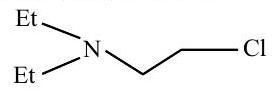
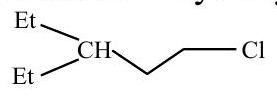
Statement I : (see structure A) will undergo alkaline hydrolysis at a faster rate than (see structure B)
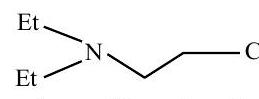
Statement II : (see structure C) intramolecular substitution takes place first by involving lone pair of electrons on nitrogen. In the light of the above statements, choose the most appropriate answer from the options given below :ABC
(A)Both Statement I and Statement II are incorrect
(B)Statement I is incorrect but statement II is correct
(C)Both Statement I and Statement II are correct✓ Correct
(D)Statement I is correct but Statement II is incorrect
Answer: (C)
Solution
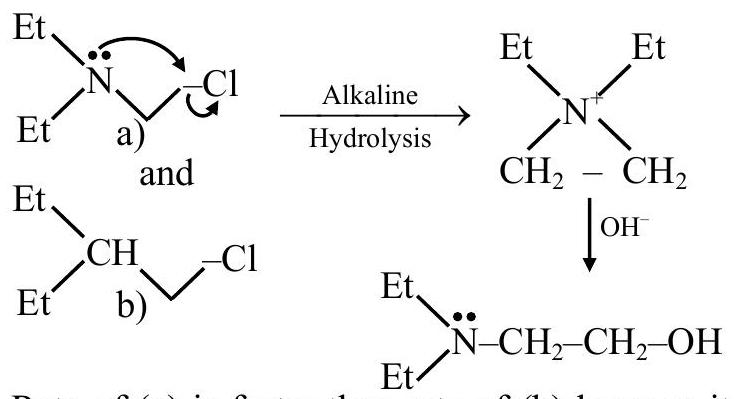
The chlorinated tertiary amine Et2N−CH2−CH2−Cl hydrolyses faster than the plain alkyl chloride Et2CH−CH2−Cl because the nitrogen lone pair, held close in space, displaces chloride intramolecularly to form a strained three-membered aziridinium (cyclic ammonium) ion before hydroxide ever gets involved. This neighbouring-group (anchimeric) assistance lowers the activation barrier compared with a direct bimolecular attack of hydroxide on the isolated chloride, which has no internal nucleophile to help it along — so Statement I is true. Statement II correctly identifies the mechanism: the intramolecular substitution by the nitrogen lone pair occurs first, and the resulting aziridinium ion is then opened by hydroxide to give the amino alcohol. Both statements are correct, and Statement II explains Statement I.
JEE Main · 2025 · 28 Jan 2025 · Shift 1 · Single correct option