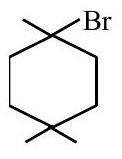
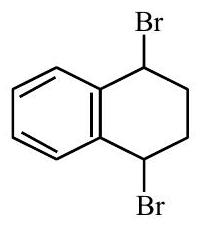
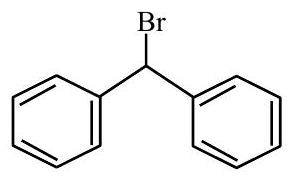
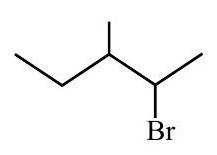
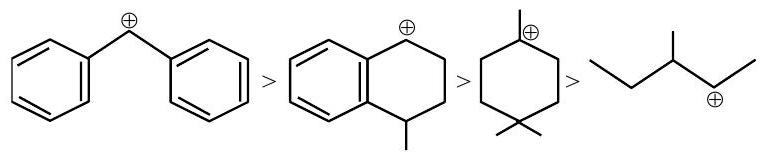
The ascending order of relative rate of solvolysis of following compounds isABCD
(A)(D) < (A) < (B) < (C)✓ Correct
(B)(C) < (B) < (A) < (D)
(C)(D) < (B) < (A) < (C)
(D)(C) < (D) < (B) < (A)
Answer: (A)
Solution
Solvolysis under SN1 conditions is governed by the stability of the carbocation intermediate — the more stable the cation, the faster the ionisation and hence the higher the rate. Compound (D) ionises to a simple secondary carbocation with no resonance stabilisation, the least reactive of the four. Compound (A) gives a tertiary carbocation on a cyclohexane ring, stabilised by hyperconjugation and inductive donation from three alkyl groups, faster than a plain secondary system. Compound (B) ionises at a benzylic position fused to an aromatic ring, so the positive charge delocalises into the ring by resonance, making it more stable than a simple tertiary cation. Compound (C) gives a diphenylmethyl (benzhydryl) cation in which the charge is shared between two aromatic rings by resonance, the most stabilised cation of the set. The resulting order of solvolysis rate is (D)<(A)<(B)<(C).
JEE Main · 2025 · 23 Jan 2025 · Shift 2 · Single correct option