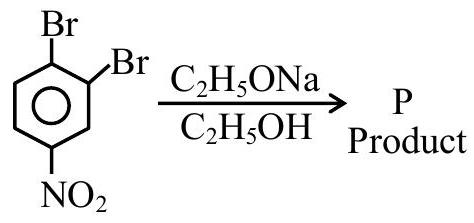
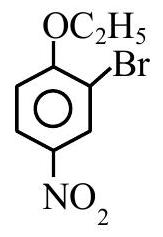
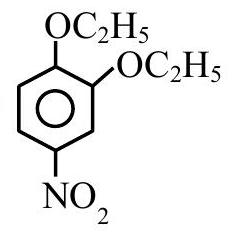
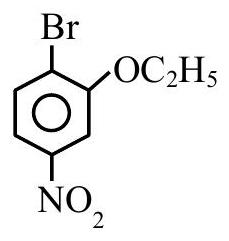
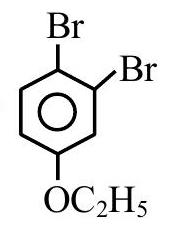
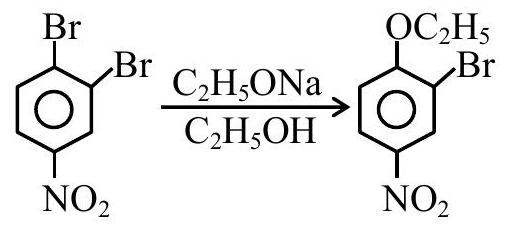
This is a nucleophilic aromatic substitution proceeding by the addition–elimination (Meisenheimer complex) pathway: ethoxide adds to the ring carbon bearing the leaving bromine, and the negative charge generated on the ring is stabilised only when it can delocalise onto the oxygens of a nitro group ortho or para to that carbon. Of the two bromine atoms on the ring, only the one positioned ortho/para to −NO2 sits on a carbon capable of forming a resonance-stabilised Meisenheimer intermediate; the other bromine, not conjugated with the nitro group, is left unreactive under these conditions. Ethoxide therefore displaces the activated bromine specifically, and the second bromine survives, giving the mono-ethoxy bromonitrobenzene shown as product P.
JEE Main · 2025 · 29 Jan 2025 · Shift 1 · Single correct option