JEE Main · 2025 · 29 Jan 2025 · Shift 2 · Haloalkanes and Haloarenes

WhatsApp Email
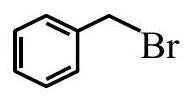
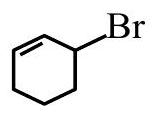
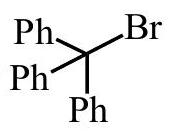
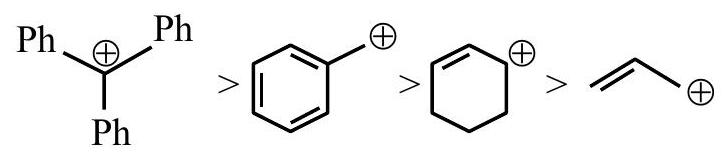
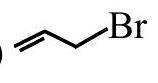
Which among the following halides will generate the most stable carbocation in Nucleophillic substitution reaction?
  1. (A)(see structure)
  2. (B)(see structure)
  3. (C)(see structure)
  4. (D)(see structure)
    ✓ Correct

Answer: (D)

Solution

Carbocation stability rises with the extent of charge delocalization available to it. A simple allylic cation delocalizes over one double bond, and a mono-benzylic secondary cation delocalizes into one aromatic ring, but a diphenylmethyl cation, , places the positive charge in conjugation with two benzene rings simultaneously. This dual resonance stabilization spreads the charge far more effectively than a single ring or a single alkene can, making the diphenylmethyl cation the most stable of the four, and its precursor halide the one that generates a carbocation most readily in nucleophilic substitution.

JEE Main · 2025 · 29 Jan 2025 · Shift 2 · Single correct option
More JEE Main questions on Haloalkanes and Haloarenes

  1. The correct order of reactivity of in methanol with the following nucleophiles is and
    JEE Main 2026View solution →
  2. The correct order of the rate of reaction of the following reactants with nucleophile by mechanism is :
    (Given : Structure I and II are rigid)
    JEE Main 2026View solution →
  3. The correct order of reactivity of the following benzyl halides towards reaction with KCN is:
    JEE Main 2026View solution →
  4. The correct order of the rate of the reaction for the following reaction with respect to nucleophiles is:
    JEE Main 2026View solution →
  5. Given below are four compounds:
    (a) n-propyl chloride
    (b) iso-propyl chloride
    (c) sec-butyl chloride
    (d) neo-pentyl chloride

    Percentage of carbon in the one which exhibits optical isomerism is:
    JEE Main 2026View solution →
  6. Consider the following reaction :


    The product Y formed is :
    JEE Main 2026View solution →