Let f(x)={−ax+a if −a≤x≤0 if 0<x≤a where a>0 and g(x)=((f∣x∣)−∣f(x)∣)/2. Then the function g:[−a,a]→[−a,a] is
(A)neither one-one nor onto.✓ Correct
(B)both one-one and onto.
(C)one-one.
(D)onto
Answer: (A)
Solution
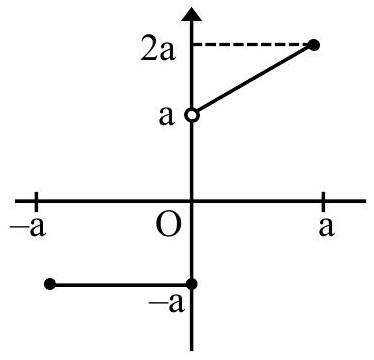
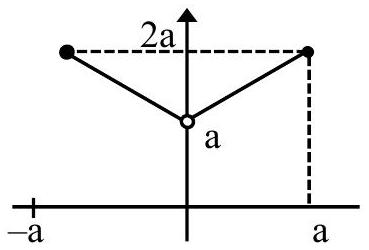
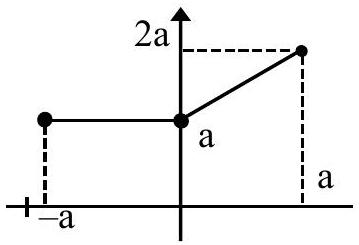
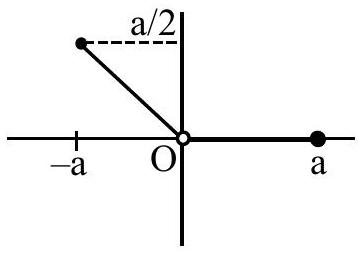
f is odd-symmetric-like on [−a,a]: f(∣x∣) mirrors f's positive-side branch, and ∣f(x)∣ reflects the negative-side branch (constant −a) up to +a. Sketching y=f(∣x∣) and y=∣f(x)∣ and forming g(x)=2f(∣x∣)−∣f(x)∣ shows g is 0 on [0,a] and equals −a on part of [−a,0) then rises — the resulting piecewise function is neither injective (repeats values) nor surjective onto all of [−a,a]. So g is neither one-one nor onto.Graph of f(x)Graph of f(|x|)Graph of |f(x)|Graph of g(x)
JEE Main · 2024 · 08 Apr 2024 · Shift 2 · Single correct option