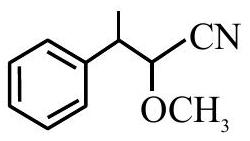
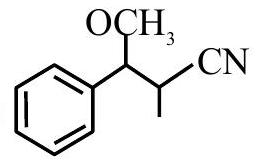
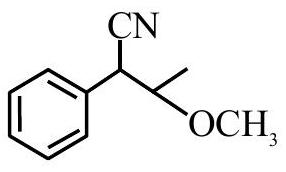
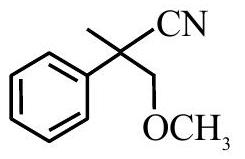
The substrate has a leaving group (Br) on a carbon adjacent to a p-methoxyphenyl-bearing centre. The electron-rich aromatic ring assists ionisation through neighbouring group participation, forming a bridged phenonium-ion intermediate. The cyanide nucleophile then opens this bridged intermediate from the face opposite to the original C–Br bond, so the net result is substitution with the configuration at the reacting carbon effectively retained (via the double-inversion pathway characteristic of anchimeric assistance).
This mechanism-consistent product corresponds to option (1).
JEE Main · 2024 · 09 Apr 2024 · Shift 2 · Single correct option