Given below are two statements : one is labelled as Assertion (A) and the other is labelled as Reason (R).
Assertion (A) : Haloalkanes react with KCN to form alkyl cyanides as a main product while with AgCN form isocyanide as the main product. Reason (R) : KCN and AgCN both are highly ionic compounds. In the light of the above statement, choose the most appropriate answer from the options given below:
(A)(A) is correct but (R) is not correct✓ Correct
(B)Both (A) and (R) are correct but (R) is not the correct explanation of (A)
(C)(A) is not correct but (R) is correct
(D)Both (A) and (R) are correct and (R) is the correct explanation of (A)
Answer: (A)
Solution
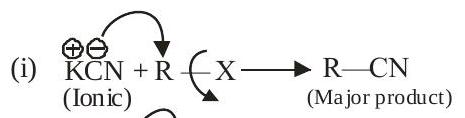
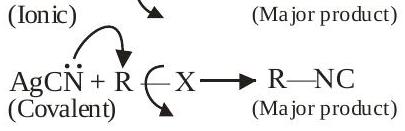
KCN is predominantly ionic, so the cyanide ion attacks through carbon (the more nucleophilic/available end), giving the alkyl cyanide as the main product. AgCN, however, is largely covalent; here nitrogen is the more available end for attack, so the alkyl isocyanide forms as the main product. This makes Assertion (A) correct. Reason (R) states both KCN and AgCN are highly ionic — this is false, since AgCN is mainly covalent. So (A) is correct but (R) is not correct.
JEE Main · 2024 · 01 Feb 2024 · Shift 1 · Single correct option