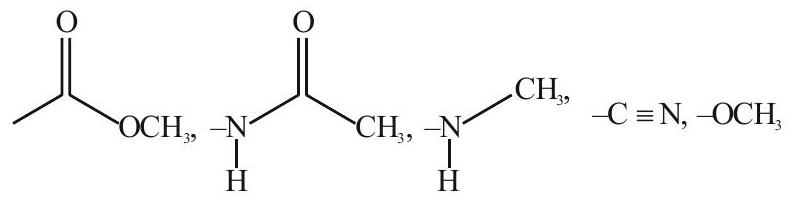
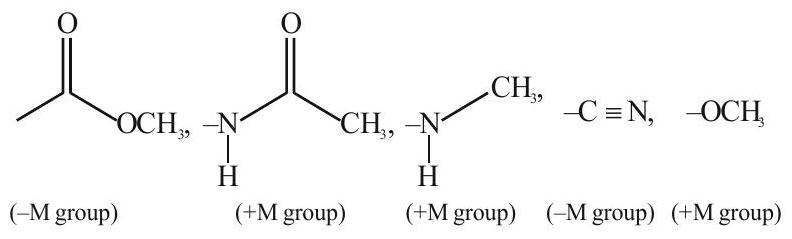
Total number of deactivating groups in aromatic electrophilic substitution reaction among the following is
Answer: 2
Solution
In electrophilic aromatic substitution, a substituent is deactivating if it withdraws electron density from the ring (net −I and/or −M effect): groups such as −OCH3 attached directly, an amide-type −N(H)C(=O)CH3, a nitrile −C≡N, etc., need to be examined individually — carbonyl-linked and cyano groups withdraw electron density and are deactivating, while an ether oxygen or an amino nitrogen directly on the ring donates by resonance and is activating. Sorting the listed groups by this criterion gives 2 deactivating groups among those shown.
JEE Main · 2024 · 01 Feb 2024 · Shift 1 · Integer answer